

A Note Before We Begin
I am a follower of Jesus Christ. That sentence is not background noise—it is the most defining fact about who I am. My faith is not something I hold alongside my identity; it is the architecture of it. I say that plainly, and without apology.
I say it here, at the top, because what follows is not a devotional. It is not a sermon. It is not an appeal to your faith or an argument for mine.
What follows is a forensic examination of a piece of linen.
The evidence presented in this essay comes from scientists, most of them non-religious. It comes from physicists, chemists, blood analysts, imaging experts, archaeologists, and historians. It comes from peer-reviewed journals and court-compelled data releases. It comes, remarkably, from a Jewish photographer who walked into a dark room in 1978 expecting to expose a fraud, and walked out a changed man.
I am presenting this evidence not because I need it to sustain my faith—I don’t—but because the evidence is extraordinary, it is largely suppressed, and you deserve to encounter it with your own eyes and your own mind.
Wherever you land, I respect the journey. But I will not pretend the evidence is thin. It is not thin. It is, in the careful language of forensic science, inexplicable.
Draw your own conclusions. That’s the whole point.
What We’re Actually Talking About
Before we go anywhere, let’s be precise about the object at the center of this conversation.
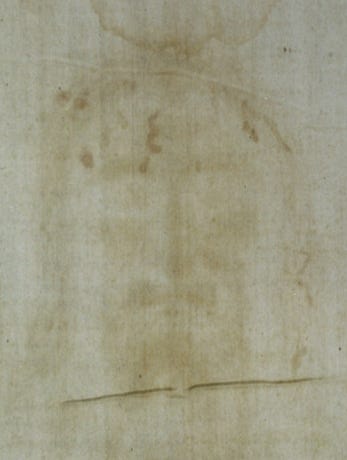
The Shroud of Turin is a strip of herringbone-weave linen cloth, fourteen feet long and three and a half feet wide. It bears the front and back image of a man—a tall man, five feet ten inches, which was unusually large for that era. The man is unclothed. He has been beaten with what appear to be spiked instruments. His wrists and feet show wounds consistent with crucifixion nails. There is a wound in his side consistent with a spear entry. His face has been struck. His scalp bears wounds consistent with a crown of thorns pressed down all the way around, not just at the front the way painters typically depict it.
The blood on the cloth is real. It is human. It is a rare type: AB positive.
The image itself is not paint. It is not dye. It is not a scorch. It is not ink. No pigments of any kind have been identified on the image fibers. The discoloration that forms the image exists only on the outermost microfibrils of the linen threads—a depth so shallow it can barely be measured.
The image contains three-dimensional spatial information. In other words, if you feed the data into a computer, it renders as a topographically accurate sculpture. Normal photographs do not do this. Paintings do not do this.
The image is a photographic negative. The lights and darks are reversed. The way we see the man with any clarity at all is by looking at the photographic negative of the cloth—which produces a stunning positive image.
Photography was not invented until 1839.
The cloth itself has been dated, by multiple independent methods, to approximately two thousand years ago.
No one—not one scientist, artist, or institution anywhere in the world—has been able to reproduce it using any materials or methods from any era.
That is what we’re talking about.
A Cloth That Survived Everything
The first documented Western appearance of the Shroud is in France in the 1350s, when a Knight Templar named Geoffroi de Charny presented it to the church at Lirey. De Charny was a man of genuine reputation—a decorated soldier, an author of treatises on chivalry, not a known forger or con man. He offered no explanation for where it came from.
Before that, its trail goes cold in the written record—but not in the forensic one. Pollen analysis of the cloth identifies species indigenous to the region around Jerusalem and to Constantinople (modern Istanbul), perfectly matching the oral history that the cloth traveled from Jerusalem northward through what is now Turkey before eventually arriving in Europe. The weave pattern itself is consistent with textile production in first-century Egypt and Judea, not medieval Europe.
In 1532, a fire broke out in the chapel at Chambéry, France where the cloth was being kept. Molten silver from the container dripped onto the folded linen and burned through the cloth in a pattern still visible today. Nuns patched the damaged sections. The Shroud survived.
In 1578, it was transferred to the Cathedral of Saint John the Baptist in Turin, Italy, where it has remained—except for a period during World War II when it was relocated to protect it from Allied bombing campaigns. The Shroud survived that too.
In 1997, the Turin chapel caught fire under circumstances that remain officially unexplained. A firefighter named Mario Trematore smashed through eight layers of bulletproof glass with a sledgehammer, bleeding through the effort, and carried the container out on his shoulders. The Shroud survived.
There is something almost stubborn about the way this piece of linen has refused to be destroyed.
The Night in the Darkroom
In 1898, the city of Turin organized a celebration marking the four hundredth anniversary of the cathedral. As part of the event, a lawyer and amateur photographer named Secondo Pia was granted permission to do something no one had ever done before: photograph the Shroud.
He set up his equipment—one of the first times electric lighting was used for photography—and made his exposures. He went to his darkroom. And then something happened that he spent the rest of his life trying to describe accurately.
When the photographic plate developed, the negative—which should have shown a dark, reversed, hard-to-read image—revealed instead a face of extraordinary clarity. Lifelike. Detailed. Perfectly proportioned. Shadows and highlights falling exactly as they would in a real photograph of a real face.
The cloth’s image was itself a negative. So Pia’s photographic negative of it produced a positive. A negative of a negative equals a positive.
He later wrote: “No human being could have painted this negative that lies hidden in the stains.”
He was accused of fraud. Thirty-three years later, in 1931, a professional photographer named Giuseppe Enrie was given access to the Shroud with superior equipment and photographed it again. His results were identical to Pia’s. Pia, then in his seventies, was present at the exhibition of Enrie’s photographs. He wept.
The question that followed both photographers home was the same one that has never been answered: if a medieval forger painted this image, how did he paint it in negative? How did he work in reverse, at microscopic precision, producing a result he could never have seen, using materials we cannot identify, to create something photography would not be invented to reveal for another five centuries?
The Scientists Who Went to Debunk It
By the 1970s, there was enough scientific interest in the Shroud that a formal investigation was organized. In 1977, more than thirty specialists—physicists, chemists, biophysicists, blood analysts, archaeologists, imaging experts—formed the Shroud of Turin Research Project, known as STURP.
Almost none of them were religious. Several were openly skeptical. The team’s unofficial consensus going in was that they would identify the method of forgery and explain it to the world.
In October of 1978, STURP was granted five days and five nights of direct, unimpeded access to the Shroud. They brought seventy-two cases of the most sophisticated imaging and analytical equipment available. They worked in shifts around the clock.
Here is what they found.
The image is not paint. Not ink. Not dye. Not a scorch. X-ray fluorescence confirmed the absence of any foreign materials on the image fibers. Ultraviolet reflectance confirmed it. Infrared analysis confirmed it. Thirty-two adhesive tape samples, analyzed under microscope, confirmed it.
The image resides only on the uppermost fibers of the cloth—a depth of roughly two hundred nanometers, a fraction of a human hair’s thickness. No known artistic or chemical process produces coloration this shallow.
The image was not drawn by brushstroke, stippling, rubbing, or any other technique of application. There is no directionality to the coloration. It appears to have formed all at once, or as if by radiation.
The bloodstains are real human blood. Type AB positive. The blood contains bilirubin, a chemical released by the liver under extreme physical trauma—consistent with severe torture. Some of the blood had flowed while the man was still alive; some had oozed after death. The blood stained the cloth before the image formed—there is no body-image beneath the bloodstains. Whatever created the image, it worked around the blood.
The blood pattern is consistent with a man crowned with a ring of thorns all the way around the skull, flogged with a two-pronged instrument by two men of different heights, forced to carry a heavy object causing falls on the face, crucified through the wrists and feet (not the palms, as artists usually depicted it), and pierced in the side with a pointed instrument.
This matches the Gospel accounts of the crucifixion of Jesus of Nazareth with a precision that is, by any statistical measure, extraordinary.
The STURP team published their final conclusions in 1981. Biophysicist Dr. John Heller delivered the summary at a press conference:
“The Shroud image is that of a real human form of a scourged, crucified man. It is not the product of an artist. The image is an ongoing mystery and, until further chemical studies are made, the problem remains unsolved.”
— Dr. John Heller, STURP Final Report, 1981
The team that went to explain the trick came home without one.
STURP member Barrie Schwortz, the team’s documenting photographer, was an Orthodox Jew who had needed to be talked into joining the project at all. He later said he joined largely because it was a free trip to Italy, and he expected to spot the paint within minutes. He spent the next forty-six years of his life as the world’s most knowledgeable and passionate advocate for the Shroud’s authenticity—still from a scientific standpoint, still citing data, never converting to Christianity. He maintained his Jewish faith. He simply could not argue with what he had seen.
He died in June of 2024 at age seventy-seven. His website, Shroud.com, remains the most comprehensive archive of Shroud research in existence.
The Debunking That Got Debunked
In 1988, the story appeared to end.
Scientists from the University of Oxford, the University of Arizona, and the Swiss Federal Institute of Technology conducted carbon-14 dating on samples from the Shroud. Their results, released with considerable fanfare, placed the cloth’s origin between AD 1260 and 1390—squarely in the medieval period. The New York Times ran the headline. The Church accepted the findings. The Shroud, the world was told, was a medieval forgery.
There were problems with this conclusion from the start, but they took years to surface.
In 2000, independent researchers Joseph Marino and Sue Benford presented a paper arguing that the corner of the Shroud from which the samples had been taken was a repaired section—almost certainly patched after the 1532 fire. If so, the tested material would be medieval linen woven into a first-century cloth, and the carbon date would reflect a blend of the two—which is exactly what the numbers suggested.
STURP chemist Ray Rogers heard about their theory and was dismissive. He had his own samples from the 1978 examination locked in a safe. He decided to look at them and prove Marino and Benford wrong in five minutes.
He called back several hours later. He said, simply: “I can’t believe it, but I think they’re right.”
Rogers’ microscopic examination found cotton interwoven with the linen in the sample area—not present in the rest of the cloth. He found evidence of a gum and dye applied to the surface of the repaired threads, apparently to match the color of the surrounding material. A second independent scientist confirmed all of his findings.
Then came the question of the raw data from the 1988 tests. The British Museum, which had overseen the carbon dating, refused to release it. That refusal stood for nearly three decades, until a French researcher filed a Freedom of Information lawsuit and a British court ordered the data released in 2019.
What the released data revealed was damning: the “three independent samples” tested by three separate labs were not, in fact, three independent samples. They were a single sample, cut from the repaired corner, then divided into thirds. The statistical independence the study claimed was an illusion.
A team of Oxford scientists reviewed the released data and formally ruled out the 1988 findings. Dr. Giulio Fanti, using spectroscopic analysis, subsequently dated the cloth to a midpoint of approximately AD 50, with a 96 percent confidence level.
The debunking had been debunked. But the correction never made the front page.
What the Evidence Keeps Saying
The carbon dating controversy is the most famous chapter of this story, but it is far from the only forensic thread worth following.
Pollen
Pollen grains extracted from the Shroud include species indigenous to the region around Jerusalem and species found in Constantinople. This matches the oral history of the cloth’s journey almost exactly. Pollen does not travel by chance across continents or centuries. It settles where it finds itself.
Roman Coins
Using imaging analysis, physicists John Jackson and Eric Jumper identified impressions on the Shroud consistent with coins placed over the eyelids—a documented burial practice of the era. Coin experts subsequently identified the specific type: lepton coins minted under Pontius Pilate, governor of Judea, circa AD 29.
Limestone
Spectrometric analysis identified calcium carbonate dust on the nose, knee, and heel of the image—consistent with a man who fell face-first while carrying a heavy object. The limestone matches the specific geological composition of stone found in and around Jerusalem to this day.
The Sudarium of Oviedo
In the Cathedral of San Salvador in Oviedo, Spain, there is a separate relic: the Sudarium, a face cloth documented in church records as far back as AD 570, kept in a locked chest since the ninth century and moved repeatedly ahead of conquering armies to prevent its destruction.
The Sudarium does not carry an image. But it carries blood—type AB positive, matching the Shroud—and pollen indigenous to Palestine. The wound patterns on the Sudarium align precisely with the facial wounds visible on the Shroud. Independent scholars calculate the probability of the same rare blood type appearing on two unrelated cloths, bearing the same wound patterns, carrying the same regional pollen, at roughly one in a thousand.
Unless they came from the same man.
The Weave
The herringbone weave pattern of the Shroud is consistent with textile production in first-century Judea and Egypt. It was not a weaving style used in medieval Europe. A forger working in fourteenth-century France would have been working with locally available cloth—and this cloth is not that.
The Skeptic’s Particular Power
There is a specific kind of testimony that carries more weight than devotion: the testimony of someone who came looking for the exit.
Lee Strobel was a journalist and legal editor at the Chicago Tribune, and a committed atheist. When his wife converted to Christianity in 1979, he decided to use his investigative skills to do her a favor and dismantle the intellectual foundation of the faith she’d adopted. He spent nearly two years interviewing thirteen leading scholars—historians, scientists, archaeologists, philosophers, medical doctors—asking every hard question he could construct. He wanted to prove that the Resurrection was a legend, a myth, or an outright lie.
He could not do it. The weight of the historical and forensic evidence—including the evidence surrounding the burial cloth—moved him from contempt to investigation to faith. He became a Christian in 1981 and subsequently wrote The Case for Christ, which became one of the bestselling works of Christian apologetics ever published, later adapted into a film. It remains required reading for anyone who wants to engage seriously with the historical claims of Christianity rather than dismiss them by assumption.
Strobel said later: “I didn’t want to believe. Belief was the last thing I wanted. But I’m a journalist. I follow evidence. And the evidence wasn’t cooperating with my conclusions.”
Barrie Schwortz said something similar. So did Ray Rogers. So did David Rolfe, the British filmmaker who began his research as an atheist trying to prove the Shroud was a hoax and ended up converting to Christianity. In 2022, Rolfe offered the British Museum one million dollars to duplicate the Shroud using only materials and methods available in the medieval period. The Museum did not accept the challenge. The money remains unclaimed.
This is the pattern. The skeptics go in skeptical and come out… different. Not all of them convert. Schwortz never did. But they stop being dismissive. The evidence won’t allow it.
What Could Have Made This
After nearly fifty years of study by some of the best analytical minds available to science, there is still no agreed-upon natural explanation for how the image was formed.
The leading scientific theory—developed by STURP physicist John Jackson and subsequently tested by Paolo DiLazzaro at the Frascati Research Centre in Rome—proposes a burst of vacuum ultraviolet radiation. Under this model, a body would have to emit an extraordinarily intense flash of UV light, measured in billions of watts, in a fraction of a second—enough to discolor the outermost fibers of the cloth without generating sufficient heat to scorch or destroy it.
DiLazzaro’s team was able to produce some of the Shroud’s image characteristics using an excimer laser, but only by applying the laser one tiny fiber at a time, in a process that would have required years and technology that does not yet fully exist. Even then, they could not reproduce the three-dimensional encoding.
Father Robert Spitzer, a physicist and former president of Gonzaga University who has studied the Shroud extensively, frames the implication plainly: there is no known physical process by which a decaying human body emits such radiation. The known laws of physics do not permit it. If the image was produced by radiation, something outside the known laws of physics was responsible.
There is one event in the Gospel accounts that would fit that description.
Whether you believe that event occurred is, of course, a matter of faith. But notice what the science is and is not saying. It is not saying the resurrection explanation is credible because we want it to be. It is saying that the only known explanation for the image’s properties requires an energy event with no natural cause. The faith conclusion and the forensic conclusion have arrived, from opposite directions, at the same door.
Why You Probably Haven’t Heard Any of This
This is the part I find most interesting, from a purely journalistic standpoint.
The 1988 carbon dating result was front-page news in every major Western newspaper. The correction—when the raw data was finally forced out of the British Museum in 2019, when Oxford scientists formally invalidated the original study, when Dr. Fanti’s spectroscopic dating placed the cloth in the first century—was barely covered at all.
The STURP findings, representing years of work by more than thirty credentialed scientists, were published in peer-reviewed journals and acknowledged that no artistic explanation for the image was possible. This information exists. It is accessible. It is cited in scientific literature. Most people have never encountered it.
In 1988, the scientists who conducted the carbon dating refused to release their raw data for twenty-seven years. When a French researcher finally obtained it through legal compulsion, it revealed methodological problems significant enough to invalidate the study’s core claims. The question of why the data was withheld has never been satisfactorily answered.
David Rolfe has offered a million dollars to anyone who can duplicate the Shroud. The offer has stood since 2022. No institution, no artist, no scientist has attempted it.
I am not in the business of constructing conspiracies where incompetence will serve as an explanation. But I am in the business of noticing when information that should be widely known is not widely known, and asking why. When the evidence for a thing runs consistently in one direction and the cultural narrative runs consistently in the other, that asymmetry is worth examining.
The Shroud has survived fire, fraud, suppression, and centuries. It is still here. The questions it raises are still unanswered. That, in itself, seems worth paying attention to.
Where This Leaves Us
Let me say clearly what this essay is not arguing.
It is not arguing that you must believe the Shroud is the burial cloth of Jesus Christ. It is not arguing that forensic evidence can compel faith, or that it should. Faith is not a conclusion you reach at the end of an evidentiary chain. It is something else entirely.
What this essay is arguing is simpler: the evidence deserves honest engagement.
We have a piece of cloth that no one can explain. Its image was formed by a process no one has been able to replicate. Its blood is real and human and rare. Its pollen and limestone and coin impressions track a journey from first-century Jerusalem. Its photographic properties were invisible until photography was invented to reveal them. Every scientific analysis has excluded artistic forgery. The dating study that appeared to settle the question was conducted on a repaired corner of the cloth, used a single sample divided into thirds, and withheld its raw data for nearly three decades.
Two thousand years ago, in a province of the Roman Empire, a man was executed in a manner precisely consistent with what is recorded on this cloth. The Gospel accounts of that execution have been confirmed as historically grounded by Roman and Jewish historians who had no stake in Christian theology. The moral framework that man left behind—love your neighbor, forgive those who wrong you, treat others as you wish to be treated—is the most revolutionary ethical proposal in recorded history.
Whether the Shroud is a divine artifact or the world’s most inexplicable unsolved forgery, you are standing in front of something that matters. You are looking at a question that serious people—scientists, historians, skeptics, atheists, and believers alike—have found themselves unable to walk away from.
I couldn’t either.
Make of that what you will.
Sources & Further Reading
Primary Scientific Research
Heller, John H. Report on the Shroud of Turin. Houghton Mifflin, 1983. The definitive account of STURP’s findings by one of the team’s biophysicists.
Rogers, Raymond N. “A Chemist’s Perspective on the Shroud of Turin.” Thermochimica Acta, Vol. 425, January 2005. Rogers’ peer-reviewed paper documenting evidence of medieval repair in the carbon-dated corner.
Fanti, Giulio, and Saverio Gaeta. Il Mistero della Sindone. Rizzoli, 2013. Documents spectroscopic dating placing the cloth in the first century.
DiLazzaro, Paolo, et al. “Sub-superficial Coloration in the Shroud of Turin.” Paper presented at the International Workshop on the Scientific Approach to the Acheiropoietos Images, ENEA Research Centre, Frascati, Italy, 2010.
Marino, Joseph G. The 1988 C-14 Dating of the Shroud of Turin: A Stunning Exposé. Independently published, 2020. An exhaustive examination of procedural errors and data suppression surrounding the carbon dating.
Historical & Archaeological
Danin, Avinoam, Alan Whanger, Uri Baruch, and Mary Whanger. Flora of the Shroud of Turin. Missouri Botanical Garden Press, 1999. Pollen analysis confirming plant species indigenous to Jerusalem and Turkey.
Adler, Alan D. The Orphaned Manuscript: A Gathering of Publications on the Shroud of Turin. Effatà Editrice, 2002. The definitive collection of blood chemistry analysis findings.
Guscin, Mark. The Oviedo Cloth. Lutterworth Press, 1998. The most thorough English-language study of the Sudarium of Oviedo and its relationship to the Shroud.
Accessible Starting Points
Strobel, Lee. The Case for Christ. Zondervan, 1998. A journalist’s investigation into the historical evidence for Jesus, including burial and resurrection accounts.
Shroud.com. The website maintained by the late Barrie Schwortz, official documenting photographer for STURP. The most comprehensive free archive of Shroud research in existence, now maintained by Joseph Marino.
Rolfe, David (director). The Silent Witness. 1978. The documentary that brought the Shroud to widespread public attention and launched Rolfe’s decades-long investigation.
Rolfe, David (director). Who Can He Be? 2022. Updated documentary presenting new evidence challenging the 1988 carbon dating, accompanied by Rolfe’s public £1 million challenge to any institution that can duplicate the Shroud.
Peer-Reviewed Publications
Benford, M. Sue, and Joseph G. Marino. “Discrepancies in the Radiocarbon Dating Area of the Turin Shroud.” Chemistry Today, Vol. 26, May/June 2008.
Jackson, John P., Eric J. Jumper, and William R. Mottern. “Mapping the 3-D Surface by Reflection Spectrophotometry.” Proceedings of the 1977 United States Conference of Research on the Shroud of Turin. Holy Shroud Guild, 1977.
Flury-Lemberg, Mechthild. Sindone 2002. Fondazione 3M, 2003. Documentation of the 2002 conservation effort and analysis of the cloth’s unique weave.
Oxley, Mark. The Challenge of the Shroud. AuthorHouse, 2010. A survey of scientific findings and unresolved questions from a non-religious standpoint.
Shroud.com remains the single best starting point for anyone who wants to go further. The library there is vast, the science is cited, and nothing is behind a paywall. Barrie Schwortz, an Orthodox Jew, never converted, built it that way on purpose.