

872 Days
Many Americans cannot tell you what the Siege of Leningrad was. They cannot tell you when it happened, or how long it lasted, or what the word blokada means, or why it should matter to them at all. I can write this, because I have surveyed over a five hundred people, from different generations, and different parts of the United States. They went through twelve years of public school. They sat in history classes. They were given textbooks and timelines and documentaries and field trips, and somewhere in all of that, 872 days of deliberate mass starvation, more than a million civilians dead in a single city, simply did not make the cut. The curriculum moved on. The children moved on.
And an entire catastrophe, one of the worst inflicted on a civilian population in the history of modern warfare, became the kind of thing that mostly only historians know about, which is another way of saying it became the kind of thing the rest of us are permitted to forget.
This has plagued me for years, since I began learning the full extent of Stalin, The Seige, and about what actually happened inside that city. Not the politics, not the military maps, not the generals. What happened at the kitchen table. What happened in the hours between waking up and trying to sleep again. Because once you know, you cannot unknow it, and I think that is exactly the point. We were never supposed to know. Forgetting requires assistance. It doesn’t just happen on its own.
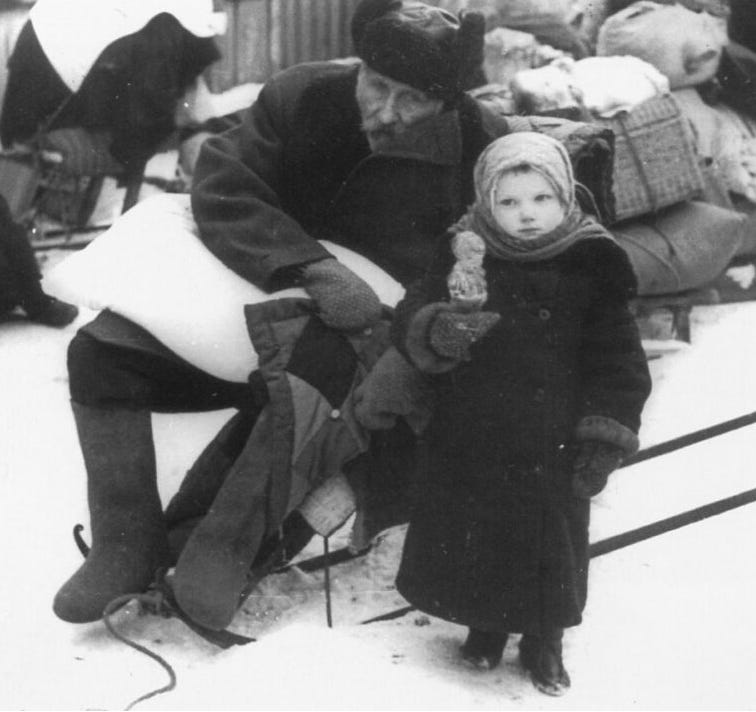
A five-year-old boy sat in front of a clock and watched it. Just watched it. His mother remembered this later, the specific quality of his stillness, the way he had learned to read the hands, the way he understood that the hands moving meant the next meal was getting closer, even though the next meal was almost nothing. He had turned time itself into food. He sat there quietly, not crying, just watching, because there was nothing else to do with the hunger except wait for it to become slightly less.
That is the image I cannot get out of my head. Not the numbers. Just a small boy and a clock, and a mother watching him from across the room, memorizing him, in case either did not wake for tomorrow.
The siege ran from September 1941 to January 1944. 872 days. By November of the first year, civilians who did not hold factory jobs received 125 grams of bread a day. One thin slice. The ration card for that allotment was nicknamed the smertnik, a word that shares its root with the Russian word for death. Someone in the bureaucracy named it that and kept using the name anyway, which tells you something about how clearly everyone understood what was happening.
The bread was not really bread. It was cellulose and sawdust and a small percentage of rye flour pressed into a shape that memory and desperation agreed to call bread, because the alternative was to admit there was no bread, and people were not ready to admit that yet. When the city ran out of malt flour, they used cotton-cake and finished cellulose. When those ran out, they boiled the mutton guts found in the seaport into a gray galantine and distributed that. When the meat was gone entirely, they boiled calf skins that survivors would describe, decades later, with the revulsion of a sensory memory that never fully left the body.
Trauma is like that. The body keeps the score.
The gas shut off first, then the electricity, then the water pipes froze. People cooked their daily allotment over small stoves burning wood shavings and pieces of furniture. Hardly anyone bothered to go to the air raid shelters anymore, because they no longer had the energy to climb up and down the stairs.
The bombs were still falling.
They just couldn’t afford the calories it cost to be afraid of them.
The women of Leningrad made soup from the glue in spines of their books. They boiled leather belts until the leather softened enough to chew. They scraped wallpaper paste from the walls because the paste had been made with potato starch and there was something in it still, some faint ghost of nutrition the body might accept. A teenage girl named Lena Mukhina kept a diary through the worst of it, and she wrote about dreaming of fried potatoes, golden and sizzling from the pan, and salami thick enough to really sink your teeth into, and hot buttery blinis with jam. She wrote: Dear God, we’re going to eat so much we’ll frighten ourselves.
She wrote this during the months when her daily ration was one thin slice of sawdust bread, when her family had already eaten the cat.
The family’s cat was carefully divided, calculating carefully how many meals were left in him.
The large number of orphans left in the city after the siege tells you what you need to know about what the parents had been doing. The historians use the word ‘suggests’. Suggests that parents sacrificed their own health for their children. That is the word they use, because the dead cannot confirm it, and the living rarely spoke of it directly. What the record shows is this: children survived at higher rates than their parents and grandparents. The math of that is not complicated. Someone was not eating. Someone was handing the bread across the table and saying they weren’t hungry, saying they’d eaten already, saying take it, go on, take it, watching the child eat with a love only a parent, or grandparent, understands.
Mothers faced impossible choices about who got food. Some gave their rations to their children. Some gave to the working adults in the household, because the working adults brought in slightly larger rations and the larger ration kept more people alive one more day. The calculus of survival inside those apartments was real and unspoken and it was being done constantly, every day, by people who had been ordinary before the war, people who had worried about ordinary things.
The cold settled into the city at the same time as the hunger, and the two things together did something to the body that each thing alone could not do as quickly. Temperatures fell to minus forty degrees Celsius, freezing the pipes, cutting the power, ending the heat. One survivor, an artist named Ilya Glazunov who had been a child during the siege, remembered sleeping in his winter coat and hat and waking up still cold, the indoors no different from the outdoors, the walls no longer a boundary between shelter and exposure.
People carried their dead to the street because they did not have the strength to bury them. The bodies froze where they were left, and the streets became something the living walked past every morning on their way to stand in bread lines that sometimes stretched twelve hours and sometimes, at the front of the line, held nothing. Two thirds of the population received little more than 125 grams of bread a day, a fraction of the calories needed to sustain life. The other third were the factory workers, fed slightly more because the living required some minimum to keep working, and the working was the only thing keeping the ring from closing entirely.
During the first winter, the starvation epidemic claimed as many as 100,000 lives per month. One man wrote in his diary: Is this my body or did it get swapped for somebody else’s without me noticing? He wrote that down. He kept writing, because writing was one of the ways they stayed human, kept the thread from breaking entirely between who they had been and what they were becoming. The women of Leningrad wrote letters to husbands at the front who might already be dead. They kept their children’s school records. They wrote diaries in cold apartments by candlelight.
Lena Mukhina’s school stayed open. Lessons continued in a shelter during air raid warnings, and through December she was still handing in essays and scolding herself for poor marks in algebra tests. She was a teenager in a dying city studying algebra and writing in her diary about the boy she liked, because teenagers are teenagers even when everything else has been taken away, because the human self insists on being specific and ordinary even inside catastrophe.
Her grandmother died that winter. Her aunt died not long after. Lena survived partly because no one in her building reported the deaths right away, which meant Lena could continue collecting their ration cards, and the food those cards represented kept her alive another month. She understood this. She wrote it down. She didn’t dress it up.
That is what I mean when I say the siege lived in the body and in the kitchen and in the face of a child watching a clock. It was not an event that happened to a population in the abstract. It was something that happened at a specific table, in a specific apartment, between specific people who loved each other and were trying to figure out who would eat today and how much and whether there was enough left to make it to morning.
By early September of 1941, one Leningrader was already recording in her diary: We have returned to prehistoric times. Life has been reduced to one thing. The hunt for food.
872 days of that.
The boy watching the clock grew up. Some of the children survived. The city survived. And the women who had made soup from book glue and handed their bread across the table and quietly buried the ration cards of their dead went on living in the city afterward, carrying what they knew about what a person will do when pressed to the absolute edge of what the body can endure, and what love looks like when there is almost nothing left to give and a person gives it anyway.
We should know their names. We should know the boy’s name. I don’t. That’s part of it too.
I wrote this piece because the lack of information provided in schools surrounding this moment in history has grieved me for some time.