

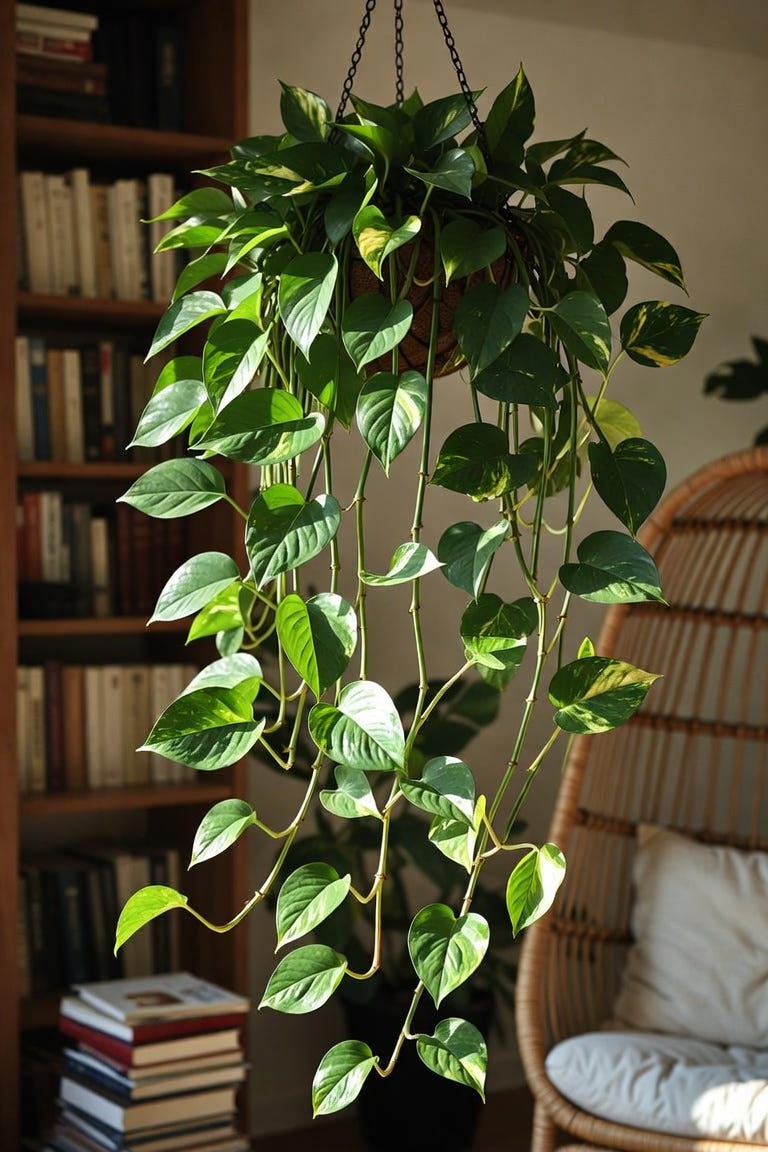
I am not the best tender to plants. Even though I name them and truly love to care for them, inevitably I forget to water and my thumb is closer to black than green. I have killed succulents, which I understand takes a special kind of talent. My friend Lindi gifted me a golden pothos for the fact that these plants really are one of the most forgiving houseplants, and it can come back from looking almost entirely dead, even from a single cutting with one healthy node. You can forget to water it for weeks and it'll just sulk a little, dropping a leaf or two, and then perk right back up the first time you remember it's alive. You can let it get leggy and bare near the base, snip the whole sad stretch of vine clean off, and it'll send out new growth like it never happened. I have read that you can take a single cutting off an otherwise dead plant, root just that one piece in a glass of water, and grow the whole thing back from there. Something in me needed a plant like that. Something that would hold on even when I forgot to hold up my end.
Let me tell you a story about a plant that couldn't recover no matter what.
There’s a science experiment I still think about, all these years later, and I wasn’t even the one who did the experiment. I was just the girl in her mid-twenties working at a high school, a lifetime ago, who wound up in the same classroom that day, probably removing a virus or installing software updates on the teacher’s laptop.
A student had grown two trays of seedlings at home, same soil, same water, same light, same temperature and humidity level, as best a kid running an experiment can control. Every variable she could account for, she’d matched. Except one. She’d set an iPhone down next to one tray and left it there, day and night, right at the start of that stretch of years when all of us were trading in our flip phones for something “smarter”, something that never really slept.
The seedlings without the phone came up thick and green, the way seedlings are supposed to.
The ones next to the phone died.
I remember her standing up there, a kid, on the brink of understanding this thing we now all have glowing in our faces may have consequences we don’t realize. Or, by now, maybe we do, and yet the gadget stays in our hand, our pocket, and on our bedside table as we sleep.
I’ve thought about those trays in correlation to my phone often. Even told my Momma about it this past 4th of July weekend while informing her of EMF protection. If I handed you this story today and told you to treat it as evidence, I’d be lying to you, and you know by now I won’t do that. But I’m not handing it to you as evidence. I’m handing it to you as a door. Because it turns out that teenager wasn’t the only person who’s stood in a room watching something green do something it wasn’t supposed to do.
Back in 1966, a man named Cleve Backster hooked up a polygraph machine, the old lie detector kind he’d spent his career reading, to a plant sitting in his office. He was just curious how fast water would move up through the leaves. But the needle didn’t do what he expected. It jumped the way a person’s does when they’re startled, or scared, or lying. So he thought about burning the leaf, just thought about it, hadn’t even moved toward a match, and the needle jumped again. He went on to run stranger tests, tests involving brine shrimp dying in another room where the plant couldn’t have seen or heard a thing, and the needle kept responding like it knew.
Backster called it primary perception, a kind of awareness that didn’t need eyes or ears or a nervous system to notice what was happening around it. His work became the backbone of a book called The Secret Life of Plants, and it swept through the seventies like a fever, part science, part longing.
Nobody could reproduce what Backster saw under real controls. Researchers tried, at Cornell and elsewhere, and what they found instead was static electricity, shifting humidity, a loose electrode, the ordinary ghosts that haunt any experiment run without enough rigor. Even MythBusters took a crack at it decades later and came up empty on the meaningful readings. Backster, for his part, tended to answer every failed replication by saying the other researchers hadn’t properly removed human consciousness from the room, which is the kind of explanation that can’t ever be proven wrong, and so can’t really be proven right either.
And still… Plants are not the inert, deaf things we were taught to believe in. They signal each other through the air with chemical warnings when something’s chewing on their leaves. They pass resources leaf to leaf, root to root, through fungal networks so extensive that scientists have taken to calling it the wood wide web. They bend toward light with something that looks like desire. None of that is consciousness in the way you and I have it. There’s no brain in there, no self looking out. But there is response. There is a kind of listening, even if it isn’t listening the way we interpret the word.
There’s another thing plants do, and this one isn’t fringe science at all. Any gardener will tell you the same thing an arborist will. A plant only has so much energy to go around, so much water, so much sugar it can make and move. A branch that’s dead or dying doesn’t quietly step aside and let the rest of the plant alone. It keeps drawing. It pulls water toward tissue that will never leaf out again, it gives disease and pests a foothold to spread from, and it shades out the growth that’s still trying to reach the light. That’s why you prune. Not out of tidiness, but because the living parts of the plant cannot fully thrive while they’re still feeding what’s already dead. Cut the dead wood away, and the plant doesn’t just look better, it redirects everything it has toward the branches that can still bear something.
Scripture never had trouble believing the Created world could hear and answer. Isaiah said the mountains and the hills would break out in singing before the Lord, and the trees of the field would clap their hands. Paul told the Romans that all of Creation groans together, like a woman in the pains of labor, waiting on something it can’t yet see. The Psalms are full of rivers clapping and hills singing for joy, and I don’t think the writers meant it only as decoration. I think they meant that the world God made is not a stage set standing empty behind us while the real story happens in human hearts. I think they meant it’s alive to Him, and alive to us, in ways we’ve trained ourselves out of noticing.
And Jesus reached for the very same picture when He wanted us to understand our own lives. I am the true vine, He said, and my Father is the gardener. Every branch that bears no fruit at all, He takes away. And every branch that does bear fruit, He prunes back, so that it can bear more. He goes on to say that a branch cannot produce anything on its own strength, cut off from the vine, and neither can we, cut off from Him. And He doesn’t soften what happens to the branch that stops abiding. It withers. It gets gathered up and burned. It isn’t a threat so much as a description of how a vine actually works, the same way that student’s dying seedlings weren’t a curse, just a plain account of what happens when something living keeps its closest company with something that drains it. Jesus wasn’t inventing a metaphor out of nothing. He was naming what every gardener knows in their hands and calling us to notice it in our souls.
We are, all of us, living through the strangest experiment of our lifetimes, carrying something that hums and glows and never fully rests, keeping it close at hand the way that student kept a phone next to that tray. I don’t know what killed those seedlings. But I know I haven’t forgotten it, and I know that not forgetting it has made me a little more careful about what I let sit close to the things I’m trying to grow, and about what dead wood I’ve let stay attached far longer than it should have. The habits and company that quietly draw on a life without ever giving anything back to it.
Psalm 42 knew what we keep forgetting, that everything made by the same hand still answers when it's called.
Maybe that’s the whole point of a story like this one, Backster’s or the student’s. Not proof. Just a small reminder that we were made for a garden that could hear us calling it by name, long before anybody needed a needle on a dial to tell us so. And some part of us, plant or person, still knows the difference between what gives life and what quietly, invisibly, takes it.
This is undoubtedly my favorite so far. I’m not sure how or where these ideas come to you but I firmly believe they are inspired by your foundational belief in God. Nothing else can account for it