

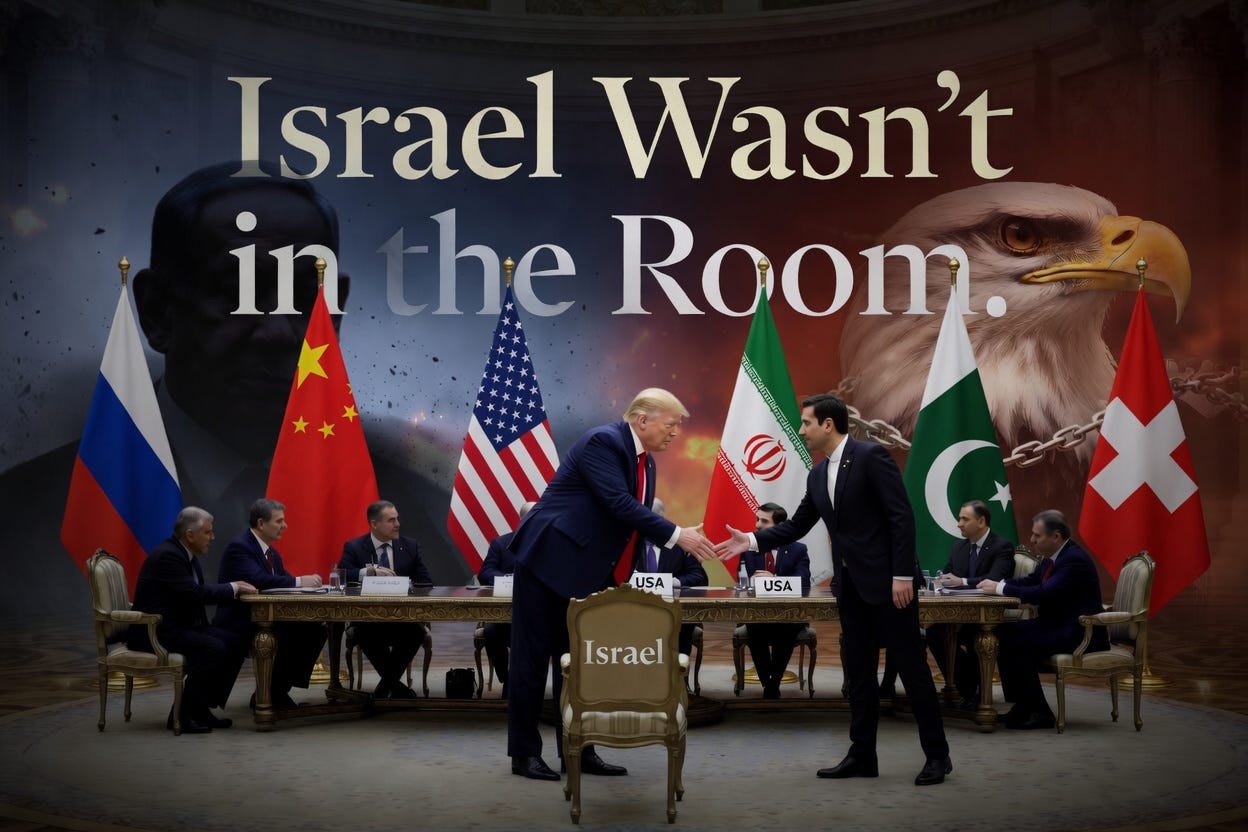
Yesterday, the United States and Iran reached a peace agreement. Pakistan’s Prime Minister announced it. Trump posted it on Truth Social. The signing ceremony is set for June 19th in Switzerland. The Strait of Hormuz, which has been largely closed since February, will reopen. Military operations on all fronts — including Lebanon — are to cease immediately and permanently.
Iran’s Supreme National Security Council confirmed that Tehran had finalized a memorandum of understanding, declaring all military operations on all fronts, including Lebanon, would cease “immediately and permanently.”
Read that again. Including Lebanon.
Israel was not at the table for any of it.
Netanyahu has said Israel is not a party to the negotiated deal, and the agreement in its current form is considered a deep disappointment by Israel’s government. Netanyahu struck Beirut anyway, hours before the announcement, and Trump said publicly that Netanyahu had almost “derailed” the deal with that airstrike on Lebanon’s capital.
Think about what just happened structurally. The United States and Israel launched joint strikes on Iran together in February. They went to war as partners. And yet when it came time to negotiate an end to that war, Trump praised Chinese leader Xi Jinping and Russian President Vladimir Putin for helping advance the settlement, while criticizing Netanyahu directly, calling him “a very difficult guy” and saying he should be “very thankful” for what the US negotiated on Israel’s behalf.
An American president thanked Russia and China for this deal. That sentence alone deserves a long pause.
The exclusion of Israel from the negotiating table wasn’t incidental. The peace terms specifically address Israeli military behavior — attacks in Lebanon, regional operations — conditions that could only exist in a framework Israel had no hand in shaping. You cannot negotiate terms about a party that is sitting across from you at the table. The architecture of this deal required Israel’s absence.
Whether that signals a genuine shift in the relationship, or a temporary rupture driven by frustration, is something we don’t yet know. What we do know is that this is not normal.
And while that diplomatic drama was unfolding, something else was moving quietly through Congress.
Section 224 and the Back Door
Section 224 of the House version of this year’s National Defense Authorization Act (NDAA), introduced on May 26, 2026, proposes a new mechanism for continued close collaboration between Israel and US military and intelligence agencies. Section 224 would not only allow the exceptionally close military relationship to continue, but would also shelter it from the vagaries of regular congressional votes on military aid and make it almost impossible to uproot.
The NDAA funds the entire framework of the Department of Defense. Things buried in it have a way of becoming permanent.
Section 224 would require the US defense secretary to appoint an “executive agent”, a single official to coordinate military cooperation between the US and Israel, covering joint research and development, shared production of weapons, and the linking of military systems and data.
The Quincy Institute for Responsible Statecraft put it plainly: Section 224 “would give Israel deeper military integration with the US than any country in the world, including NATO allies.”
Josh Paul, a former State Department official who resigned over US arms policy toward Israel and now runs the advocacy group A New Policy, said it directly: “What Congress is trying to do now is find different ways of entrenching the relationship so deep in America’s own defense industrial base that it’s impossible to root it out.”
As political pressure builds to reduce US military assistance to Israel, Section 224 provides the framework for continuing and expanding those ties by entrenching Israeli technology within the US defense supply chain in a way that would shield it from the annual appropriations process. Translation: if this passes, future Congresses and future presidents face a structural obstacle to changing course, one built by this Congress, right now, while the country is watching Lebanon burn and waiting to see if a peace deal holds.
On June 4th, Democratic Congressman Ro Khanna introduced an amendment to strike Section 224 from the bill. The committee voted it down. Republican Thomas Massie has said he will oppose the provision on the House floor. The full Congress has not yet voted.
Netanyahu has recently claimed he wants to end Israel’s reliance on US military aid within ten years, and critics note that provisions like Section 224 would ensure Israel gets American cooperation by other means, bypassing the public accountability that comes with a straightforward aid package.
This is the part worth watching. A peace deal was just announced without Israel’s involvement. And simultaneously, a provision is moving through Congress that would make the US-Israel military relationship harder to monitor, harder to debate, and harder to undo than it has ever been.
Those two things are happening at the same time. That’s not a coincidence. It’s a competition between diplomatic momentum toward a new regional order, and a legislative effort to lock in the old one before the window closes.
Where Does Trump Stand?
That’s the question nobody can answer cleanly right now, because Trump hasn’t said.
Section 224 is a Congress initiative, not a White House one. The analysts tracking it describe Israel’s supporters in Congress as racing to lock in the relationship while they still control the legislature, before the November midterms and public opinion hardens further, before the political window closes. They are moving fast precisely because the climate is shifting.
And the climate is shifting in part because of Trump himself. On the same day he announced this peace deal, he publicly called Netanyahu a difficult guy, credited Russia and China for the outcome, and said Israel should be grateful for American protection. That is not the posture of a president eager to permanently fuse America’s defense industrial base with Israel’s.
Congressman Khanna made that same argument during the committee debate, framing his opposition to Section 224 in explicitly Trumpian language: “I am for Team America. I am for the interests of this country, and I believe that’s what Donald Trump ran on. That includes American interests against any foreign country.” The committee voted him down anyway.
The American people are paying attention. A May 2026 poll found that only 16% of Americans want the United States to keep supplying Israel with weapons without new restrictions, while 38% want weapons transfers stopped entirely.
Congress should be listening to that. The question is whether Trump will make them.
A final thought…
Netanyahu struck Beirut hours before the announcement, which suggests he was racing against the clock. And now the ceasefire terms explicitly cover Lebanon, negotiated without him in the room.
The wildcard is enforcement. The agreement says military operations on all fronts cease “immediately and permanently”, but Israel has consistently said it doesn’t consider itself bound by the deal’s terms. So the real pressure point becomes Trump. If Israel continues strikes on Lebanon and Trump follows through on withdrawing support, that’s a genuinely new dynamic. If he blinks, the agreement’s teeth come out fast.
What’s worth watching is how Israel responds in the next 72 hours before the June 19th signing in Switzerland. That response will tell us more about where the US-Israel relationship actually stands than any diplomatic statement will.