

Everything in this series is documented. Every claim has a source. The truth is disturbing enough. All articles are on my Substack and my website. Start anywhere, the thread ties it all together.
The state of Georgia is known for a number of interesting things along the state’s history. Peaches, for sure, although peanuts remain the number one crop. The birthplace of Coca-Cola and countless musicians shaping culture – Ray Charles, Alan Jackson, and my personal favorite, The Allman Brothers Band – just to name a few. Georgia is home to a number of spectacular geographical miracles like Amicalola Falls, Tallulah Gorge, and the Okefenokee Swamp. The Chattahoochee river is the dividing line between Georgia and Alabama, and has been turned into a whitewater rafting adventure. I’m from the area and I know that we call the River the black death and the drowning machine for a reason. As much as I love to look at her and the wonder of her underwater vortex surface, I know good and well if that current snatches you under, you ain’t coming back up.
I lived in Georgia for more than forty years before I broke the age old rule and moved across the River to Sweet Home Alabama.
I was born in Georgia when Ronald Reagan was in the White House and the Cold War still felt like it might end the world. I was there through the nineties, through September 2001, through every election and every crisis and every ordinary humid day that makes up a life lived in one place for a very long time. I know a good bit about the state and the history.
I never once heard of the Georgia Guidestones.
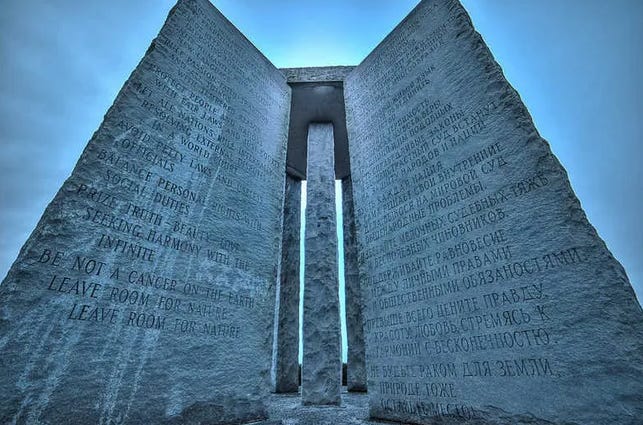
Not from a neighbor. Not from a history teacher. Not from a news broadcast or a road sign or a conversation at a church potluck. Ninety miles east of Atlanta, in a cow pasture in Elbert County, stood a granite monument nineteen feet tall, weighing nearly 120 Tons, inscribed with instructions for the future of the human race in eight modern languages and four ancient ones. It had been there since 1980. It drew 20,000 visitors a year by the time it was destroyed in 2022.
I found out about it while researching The Paper Trail.
That little detail matters more than it might seem. I had already been writing about population control, about forced sterilization programs, forced abortion policies, pandemics, wars, about the documented machinery by which powerful institutions have decided, in various eras and various languages, that there are too many of the wrong kinds of people on the earth. I had already been sitting with that material when I came across a granite monument in my home state that said, in plain English, chiseled into stone meant to outlast civilization itself:
Maintain humanity under 500,000,000 in perpetual balance with nature.
The current world population is eight billion people.
Someone built a monument in Georgia during my lifetime to say that number needs to come down by roughly 93 percent. And they built it anonymously, which means they either expected no consequences or they knew exactly what consequences to avoid.
Both possibilities are worth considering.
In June of 1979, a man walked into the offices of the Elberton Granite Finishing Company in Elbert County, Georgia.
He gave his name as R.C. Christian. It was not his name.
He told Joe Fendley, the company’s president, that he represented a small group of loyal people who had been secretly planning a granite monument for twenty years. He said they believed civilization was heading toward catastrophe — social, nuclear, or economic — and they wanted to leave instructions for whatever remained of humanity on the other side of it. He had specifications, a scale model, and knew exactly what he wanted.
Fendley thought he was a nut.
He responded the way a reasonable businessman responds to someone he wants to get rid of: he quoted a price several times higher than anything the company had previously undertaken, a number designed to send the man back out the door he came in through.
R.C. Christian accepted it without hesitation.
Fendley passed him to the local banker, Wyatt Martin, reasoning that if Christian could actually produce the funds, the project might be worth taking seriously. Martin met with Christian and told him he would need to provide his real name for the financial arrangements to proceed.
Christian provided it. He also had Martin sign a non-disclosure agreement and made him promise to destroy all the paperwork once the project was complete. Martin agreed. He kept Christian’s secret for the rest of his life. He took it to his grave.
From that point forward, Christian communicated with Martin only by mail. The letters came from cities all over the country and never from the same place twice.
The monument was completed in nine months. It was unveiled on March 22, 1980, before an audience of between 200 and 400 people, depending on the account. A congressman was present. A message was read on behalf of the sponsors: ‘we believe our precepts are sound and they must stand on their own merits’.
The name of the group was never disclosed and the identity of R.C. Christian was never confirmed. A documentary filmmaker in 2015 claimed to have found him, a man named Herbert Kersten, with alleged ties to eugenics organizations and Rosicrucian philosophy. Though the claim was never proven, the pseudonym itself is widely understood as a reference to Christian Rosenkreutz, the legendary founder of the Rosicrucian order — a secretive mystical brotherhood whose origins trace to fifteenth century Germany.
Whether that connection is intentional or coincidental, no one alive can say with certainty.
What can be said is this: someone spent the equivalent of $400,000 in today’s dollars to chisel a message into granite designed to outlast human civilization, then made absolutely certain no one would ever know who they were.
That’s not quite the behavior of a person with nothing to hide. Its also not the behavior of a person who expected to face consequences. In other words, it just don’t add up.
And the behavior of a person who was very confident about what was coming.
The monument was built from stone quarried at a place called Pyramid Quarry.
Three miles west of Elberton, where workers had to dig more than one hundred feet into the earth to find slabs of granite large enough for what R.C. Christian had in mind. Pyramid Blue Granite. From Pyramid Quarry. For a monument built to outlast civilization.
You are welcome to decide what you make of that.
The structure itself stood nineteen feet and three inches tall, made from six granite slabs weighing a combined 237,746 pounds — nearly one hundred twenty tons of stone. Four outer slabs arranged in a paddlewheel configuration. A center column called the Gnomen Stone (like a sun-dial). A capstone connecting them all. The astronomical specifications were so precise that the Elberton Granite Finishing Company had to bring in an astronomer from the University of Georgia to execute them.
Here is what those specifications required.
A hole drilled through the center column at an angle, precisely calibrated so that the North Star could be seen through it at any hour of any night, in any season, regardless of the time of year. A slot carved through the same pillar aligned with the rising sun on the solstices and equinoxes — the four hinge points of the ancient calendar used by every major civilization that predates our own. A 7/8 inch aperture in the capstone positioned so that at noon each day a beam of sunlight passed through it and illuminated the exact day of the year on the center stone below. The four outer stones oriented to mark the limits of the 18.6-year lunar declination cycle.
This isn’t the same type of thing as elaborately decorating a house in high-cotton. This is a functioning astronomical observatory built into a granite monument in a cow pasture in Elbert County, Georgia, using the same principles that governed the construction of Stonehenge, the Egyptian temples at Karnak, and the Mayan calendar complexes at Chichen Itza. The comparison to Stonehenge was made immediately and has never been disputed. What those ancient structures shared, beyond their astronomical precision, was this: they were built by people who understood that knowledge encoded in stone outlasts knowledge encoded in any other medium. They were built to be read by whoever came after.
R.C. Christian understood this and his specifications prove it.
The site itself was not chosen at random. Christian selected the highest point in Elbert County, commanding unobstructed views to the east and the west, essential for the solstice and equinox alignments. What he may or may not have known, and what the New Georgia Encyclopedia records without commentary, is that the Cherokee people had a name for that area long before any granite company operated near it. They called it Al-yeh-li A lo-Hee.
The center of the world.
As detailed as Mr. R.C. and his fellow friends were, I have a gut feeling he knew this quite well and chose it on purpose.
The capstone that sat atop the monument carried its message in four languages. Not the eight modern languages of the inscriptions below — English, Spanish, Swahili, Hindi, Hebrew, Arabic, Chinese, and Russian — but four ancient ones. Babylonian cuneiform. Classical Greek. Sanskrit. Egyptian hieroglyphics.
Let these be guidestones to an Age of Reason.
The choice of those four languages cannot be incidental. Babylonian cuneiform is among the oldest writing systems on earth, developed in Mesopotamia, the cradle of recorded civilization. Sanskrit is the sacred language of the Vedic tradition, the root of the oldest continuously practiced religious texts in human history. Classical Greek is the language of philosophy, of Plato and Aristotle, of the intellectual foundations of Western thought. Egyptian hieroglyphics are the language of a civilization that built structures of such astronomical precision that modern engineers still study them.
These are not languages chosen for reach. Arabic reaches more people than Sanskrit. Latin reaches more scholars than Babylonian cuneiform. These four were chosen for what they represent — the oldest, deepest streams of human knowledge, all of them rooted in astronomy, sacred geometry, and the measurement of time.
Someone who chose those four languages knew exactly what they were doing.
Now consider the name on the monument. R.C. Christian. A pseudonym, admitted freely and from the beginning. The initials R.C. have a documented history that predates this monument by several centuries. The Rosicrucian Order, a secretive philosophical brotherhood whose origins trace to late medieval Germany, established foundational rules for its members. The fifth rule stated that the letters R.C. should be their seal, their mark, and their character from that time forward. The sixth rule specified that the Fraternity should remain unknown to the world for one hundred years.
Two anonymous manifestos published in Germany, Fama Fraternitatis RC and Confessio Fraternitatis, outlined the society’s interests and intentions while maintaining the complete secrecy of its membership. Anonymous documents, published without attribution, outlining a philosophy intended to guide humanity toward a new age of reason.
The Georgia Guidestones were anonymous, published in granite, outlining a philosophy intended to guide humanity toward an age of reason.
The Rosicrucian order sought, in its own stated terms, to prepare a new phase of religion for a coming age. It was explicitly opposed to Catholicism. It held a doctrine built on esoteric truths of ancient Egypt, Babylon, and the Druids — concealed from ordinary people — that provided insight into nature, the physical universe, and the spiritual realm. It was linked historically to the Knights Templar before it and the Freemasons after.
None of this proves R.C. Christian was a Rosicrucian or a Mason. What it proves is that whoever he was, he used their initials, their methods, their languages, their timeline, and their stated purpose and then built it into one hundred and twenty tons of stone quarried from a place called Pyramid Quarry on land the Cherokee called the center of the world.
You are, again, welcome to decide what you make of that.
Here is what was written on the stone.
In English. In Spanish. In Swahili. In Hindi. In Hebrew. In Arabic. In Chinese. In Russian. The same ten lines, repeated in each language, facing outward in every direction, meant to be read by whoever survived.
One.
Maintain humanity under 500,000,000 in perpetual balance with nature.
The current population of the earth is eight billion people. The number carved in stone calls for a world of five hundred million. That is a reduction of ninety-three percent. Whoever survives the catastrophe — the social, nuclear, or economic calamity R.C. Christian believed was coming — inherits a world with room for one in every sixteen people alive today.
Two.
Guide reproduction wisely — improving fitness and diversity.
The word for the managed improvement of human reproduction through selective breeding has been in use since 1883. It is eugenics. The Guidestones do not use that word. They don’t even need to.
Three.
Unite humanity with a living new language.
A single global language. Not the preservation of existing languages — a living new one. Designed. Implemented. Universal. Antithetical to Genesis 11, when God specifically confused the people’s languages due to their unholy acts.
Four.
Rule passion — faith — tradition — and all things with tempered reason.
Faith is listed here alongside passion and tradition as a thing to be ruled — governed, managed, subordinated to reason. Not protected. Not preserved. Ruled.
Five.
Protect people and nations with fair laws and just courts.
Six.
Let all nations rule internally resolving external disputes in a world court.
A world court. A single international body with authority to resolve conflicts between nations. Not a suggestion. A principle carved in stone and addressed to the survivors of civilization’s collapse, as the foundational structure of whatever comes next.
Seven.
Avoid petty laws and useless officials.
Eight.
Balance personal rights with social duties.
Of all ten principles carved into the stone, this one might be the most dangerous precisely because it sounds the most reasonable. It has the cadence of civics. It reads like something that belongs in a school textbook or a UN declaration, and in fact language nearly identical to it appears in both. Not alarming and not provoking.
But read it again, and ask the question it never answers.
Who decides when the balance tips? The individual is not the arbiter of this balance, by definition, because the individual is one half of the equation and the social duty is the other. Someone external to you must determine when your personal right has exceeded its permitted weight. Someone with the authority to enforce the correction.
Nine.
Prize truth — beauty — love — seeking harmony with the infinite.
Ten.
Be not a cancer on the earth — leave room for nature — leave room for nature.
The last line is the only one repeated. It appears twice on the stone. Be not a cancer on the earth. The word chosen for humanity’s relationship to the planet is cancer. Not steward. Not inhabitant. Not creature. Cancer.
These ten principles covered, in the monument’s own stated terms, four areas: governance and the establishment of a world government. Population and reproduction control. The environment and humanity’s relationship to nature. And spirituality.
A world government. Controlled reproduction. Managed population. Faith subordinated to reason.
That is what was written on the stone.
Now set it beside what was written in New York in 2015.
The United Nations 2030 Agenda for Sustainable Development, adopted unanimously by all member states, describes itself as a plan of action for people, planet, and prosperity. It calls for universal goals applicable to every country on earth. It calls for global partnership, collective action on population and environment, and governance structures that transcend national boundaries. It establishes 17 goals and 169 targets to be implemented by the same international institutions the Guidestones called a world court.
The Guidestones said: let all nations resolve external disputes in a world court. The 2030 Agenda established the UN High-Level Political Forum as the central global platform for review and accountability of every signatory nation’s progress toward the goals.
The Guidestones said: guide reproduction wisely. The 2030 Agenda includes targets on reproductive health, population planning, and what it calls sustainable consumption — meaning how many resources each human life is permitted to use.
The Guidestones said: rule passion and faith with tempered reason. The 2030 Agenda commits all signatory nations to gender equality targets, educational transformation, and values-based programming to be implemented universally — across every culture, every tradition, every faith.
The Guidestones were carved in 1980 by an anonymous group that had been planning for twenty years.
The 2030 Agenda was adopted in 2015 by every government on earth.
The language isn’t identical, but I will leave the conclusion to you.
On July 6, 2022, at approximately four in the morning, someone detonated an explosive device at the Georgia Guidestones.
CCTV footage captured the detonation. A vehicle was recorded leaving the scene. The explosion destroyed the Swahili and Hindi language slab and damaged the capstone — the stone that carried the message in Babylonian cuneiform, Classical Greek, Sanskrit, and Egyptian hieroglyphics. The one that said: let these be guidestones to an age of reason.
Later that same day, the Georgia Bureau of Investigation arrived with a backhoe and demolished what remained. Within hours of the bombing, the stones that had stood for forty-two years were rubble.
The GBI investigation produced no arrest and no suspect was named publicly. The case remains open.
Here is what else the demolition produced: when county officials dug six feet beneath the explanatory tablet — the stone that had announced, in plain English, that a time capsule had been placed six feet below this spot — they found nothing. No capsule. No contents. No record of what was to be opened, or when, or by whom. The fields on the stone reserved for those dates had been left blank from the beginning. Whoever built the Guidestones either never buried the capsule or removed it before anyone could look.
Something was always meant to be there. Whatever it was, it was gone.
Now consider the timing.
In the spring of 2022, a Republican candidate for governor of Georgia named Kandiss Taylor made the destruction of the Georgia Guidestones a centerpiece of her campaign. She called them satanic. She said she would tear them down. She lost the primary in May. The stones were bombed in July.
No connection between Taylor’s campaign and the bombing has been established. The GBI said it was investigating and has not announced a conclusion.
The mayor of Elberton announced plans to reconstruct the monument exactly as it was. The city council voted instead to return the land to its previous owner and donate the remains to the Elberton Granite Association. As of the writing of this installment, no reconstruction has taken place.
Whatever message was meant to outlast civilization lasted forty-two years when someone or some people decided this thing has to go.
More than forty years living in Georgia and I found out about them while following a paper trail that had already taken me through a luxury hotel in Manhattan, a directive signed on March 25, 2020, a nursing home death count that was falsified for political reasons, two empty hospital ships, and a financial incentive structure that paid thirty-nine thousand dollars to put a dying person on a ventilator.
The Guidestones did not cause any of that. They preceded it.
They were built in 1980 by a group of people who believed civilization was heading toward catastrophe and wanted to leave instructions for what should come after. Population under five hundred million. Reproduction guided wisely. Faith ruled by reason. A world court. A living new language.
By 2015 those instructions had been adopted, in different language and with different branding, by every government on earth.
By 2020 a global crisis had demonstrated, in real time, how efficiently the machinery for managing populations, suppressing inconvenient information, and consolidating institutional authority could be activated — and how precisely it followed recommendations that had been written and published before the crisis began.
By 2022 the stones were gone.
I don’t know who built them. I don’t know who destroyed them. I don’t know whether the catastrophe R.C. Christian believed was coming has already happened or is still ahead of us.
What I know is what the record shows.
Someone wrote instructions for the world after the end of the world, carved them into stone, and hid their name.
Someone else came in the dark with explosives and made sure the stones couldn’t be read anymore.
Both of them knew something the rest of us were not supposed to.
The paper trail continues.
Sources
1. New Georgia Encyclopedia: Georgia Guidestones. Last modified July 11, 2022. georgiaencyclopedia.org
2. Wikipedia: Georgia Guidestones. en.wikipedia.org/wiki/Georgia_Guidestones
3. Wired Magazine: “American Stonehenge: Monumental Instructions for the Post-Apocalypse.” 2009.
4. All That’s Interesting: “The Georgia Guidestones, The Granite Monument Built To Be A Solar Calendar — And A Post-Apocalyptic Guide.”
5. Elbert County Chamber of Commerce: Georgia Guidestones history and construction documentation.
6. Georgia Bureau of Investigation: Press releases on the July 6, 2022 bombing and demolition.
7. United Nations: Transforming Our World: The 2030 Agenda for Sustainable Development. Resolution 70/1, adopted September 25, 2015. sdgs.un.org
8. United Nations: The 17 Sustainable Development Goals. sdgs.un.org/goals
9. Rosicrucian Order (AMORC): Fama Fraternitatis RC and Confessio Fraternitatis — documented historical manifestos, 17th century Germany.
10. Crystal Links: Georgia Guidestones documentation. crystalinks.com/gaguidestones.html
11. Elberton Star: Report on excavation revealing no time capsule beneath the explanatory tablet, July 2022.
12. AtlasObscura: Georgia Guidestones entry. atlasobscura.com
13. Compact Histories: “The Mystery of the Georgia Guidestones.” compacthistories.com
14. R.C. Christian (pseudonym): Common Sense Renewed. 1986. (Published statement of authorship of the Guidestones inscriptions.)