

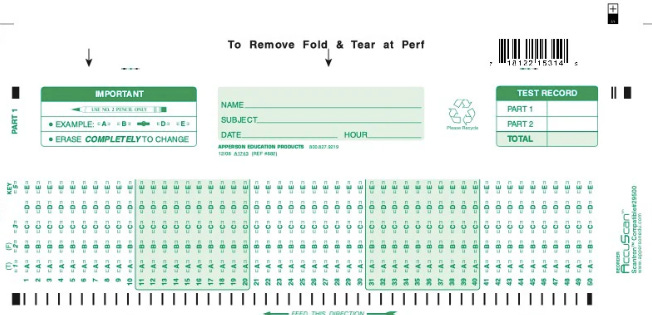
There’s a question I’ve never been able to shake, one that started forming somewhere between my own childhood at a kitchen table with my mother and the morning I watched my first child sit across from me doing the same: Who decided that a number on a scan sheet tells you anything true about a child?
Not a teacher. I’ve never met one — not a single one worth her salt — who believes that. Ask any classroom teacher, off the record, away from the administration, and she’ll tell you: standardized testing doesn’t measure intelligence. It doesn’t measure curiosity, or grit, or the way a kid’s face changes when something finally clicks. It measures how well a child performs on a standardized test. That’s it. That’s the whole thing.
So if teachers hate it, and parents are increasingly skeptical of it, and study after study shows it doesn’t reliably predict meaningful outcomes — then why does it persist? Why does it grow?
Follow the money.
A Company You’ve Never Voted For Is Running Your Child’s Education
Pearson PLC is a British education conglomerate that most American parents couldn’t pick out of a lineup. That’s by design. You don’t need to know the name of the company to take the test. You just need to show up and fill in the bubbles.
But Pearson has been quietly, methodically positioning itself as the infrastructure of American public education for decades. Between 2010 and 2014 alone, Pearson received 27 out of 128 state education contracts — more than any other company in the industry. In Tennessee, state funds flowing to Pearson nearly tripled, climbing from roughly $7 million to $22 million in just four years.
This isn’t organic growth. This is the result of policy — specifically, a federal initiative called Race to the Top, which used grant money to incentivize states to adopt Common Core standards. And who was perfectly positioned to supply the Common Core-aligned testing materials, textbooks, and digital curriculum those states now needed?
Pearson.
The Race to the Top program didn’t just set educational standards. It created a captive market. States that wanted federal dollars had to play ball, and playing ball meant buying from the handful of companies already at the table. Pearson was the biggest one sitting there.
What Common Core Actually Did
Let me be clear about something: the debate over Common Core isn’t a left-right issue, no matter how it gets packaged. The opposition came from homeschoolers and teachers’ unions alike, from conservative parents and progressive educators. What they all recognized — from different angles — was the same thing: Common Core was less an educational philosophy than a standardization mechanism.
Standardization is great for manufacturing. It is corrosive in education.
When you standardize outcomes, you necessarily standardize inputs. You teach to the test. Not because teachers want to — trust me, they don’t — but because jobs, school funding, and district reputations are now tied to those scores. The teacher who would rather spend an afternoon on a rabbit trail about the American Revolution because one kid asked a great question? She can’t afford to. That rabbit trail doesn’t show up on the assessment rubric.
The child sitting in that classroom — the one whose brain lights up for history but goes dim for math — gets a number. The number follows her. And somewhere, a company invoices a school district for the privilege of generating it.
The Conflict Nobody Wanted to Name
Here’s where the story gets uncomfortable, and where I want to be precise — because precision is how you stay credible.
The Obama administration was the primary engine behind Race to the Top and the federal push for Common Core adoption. The Department of Education under Arne Duncan spent years cajoling, incentivizing, and pressuring states to standardize. And the contracts flowed accordingly — to Pearson most of all.
Now. After leaving office, Barack and Michelle Obama signed a joint book deal with Penguin Random House reported to be worth $65 million — a figure that shattered previous records for political memoirs.
Penguin Random House was formed in 2013 through a merger of Random House and Penguin Group. At the time of that merger, Pearson owned 47% of the new combined entity. Pearson was a near-equal co-owner of the publisher that would later write the Obamas a nine-figure check.
Critics called it a quid pro quo. That’s a strong charge, and I’m not going to make it as a statement of fact — there’s no smoking-gun evidence of a direct arrangement. What I will say is this: the corporate relationships were real, the timeline is what it is, and the people who benefited from the policy are the same people who made the policy. That’s not a conspiracy theory. That’s a description of how influence works in America.
What’s also true: Pearson reportedly lost money on the Common Core curriculum because public backlash caused states to retreat from the program. The arrangement, if it was one, didn’t go the way anyone planned. Which is sometimes how these things go.
But here’s what doesn’t get walked back: the structural problem. The fact that a private corporation can simultaneously supply the tests, write the curriculum, publish the textbooks, and hold equity stakes in major publishing houses — while lobbying the federal government and receiving billions in public education contracts — is a problem whether or not any single deal was corrupt.
What Your Child’s Test Score Is Actually Paying For
Let me put some texture on this.
Every time a state administers a standardized test, money moves. It moves from state budgets — funded by your property taxes — to testing companies. Pearson. College Board. ETS. The big three of American educational assessment have collectively built an empire on the premise that children must be measured, ranked, and sorted on a regular basis by instruments that the people closest to those children — their teachers — largely believe are invalid.
College Board alone reported revenues of over a billion dollars in recent years, largely from the SAT and AP exam programs. These are nonprofit revenues, mind you — College Board holds nonprofit status while paying its executives salaries that would make a Fortune 500 CEO comfortable.
And who sits on the boards of these organizations? Who consults for them, writes policy papers that feed into federal education guidelines, and then cycles back into government positions? The same relatively small ecosystem of people. Education reform, as an industry, has produced its own version of the revolving door.
The teacher in the classroom — the one who knows your child’s name, who noticed she struggled in October and thrived in March, who can tell you exactly what kind of learner she is — has no seat at that table.
Why I Pulled My Children Out
I want to bring this home, because data without stakes is just noise.
My children are homeschooled. The journey began 14 years ago with my second born deciding she was not going to waste her time in a desk, under florescent lights being talked at, and then bubbling a Scantron sheet. That choice wasn’t made in opposition to learning — it was made in pursuit of it. Because I knew, from experience, what an education looks like when it isn’t shaped by the demands of a test someone else designed to generate someone else’s revenue.
It looks like rabbit trails. It looks like a morning spent on one question because the question was worth it. It looks like a child who reads voraciously not because she’s been leveled and assessed but because no one ever told her books were supposed to be hard.
Standardized testing has never been able to capture that. It was never designed to. It was designed to produce a number that a bureaucrat can point to, that a politician can campaign on, and that a corporation can invoice.
The teachers know this. They’ve known it for years. The ones leaving the profession in record numbers — the ones citing “teaching to the test” as a primary reason — they’re not wrong. They’re exhausted from being instrumentalized in a system that was never really about the children.
What Questions You Should Be Asking
I’m not here to hand you conclusions. I’m here to hand you questions. The road to wisdom is questioning, not only the status quo, but every piece of information you receive. Don’t take my word on anything; seek out truth and arrive at a conclusion you can live with.
Who benefits when your child’s school is evaluated primarily on test scores? Who profits from the tests themselves? Who writes the curriculum materials, and who owns equity in the companies that do? When federal money flows to states with strings attached — adopt this standard, use this assessment — who is sitting at the table when those standards are written?
The answers aren’t hidden. They’re just not on the front page. They’re in contract databases, merger filings, nonprofit tax returns, and the board rosters of organizations most people have never heard of.
Your child isn’t a data point. The machine that wants to treat her like one has names, addresses, and annual reports.
Go find them.
Love,
Momma Jess
If this piece made you think, share it with someone who’s still inside the system — a teacher, a school board member, a parent who’s been told the test is just how things are. It isn’t. It’s how things were decided. Those are different.