

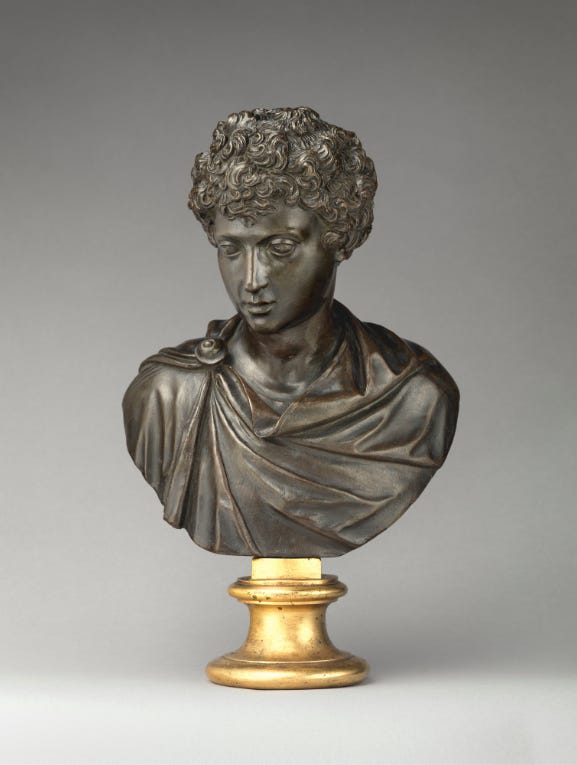
Marcus Aurelius, Roman emperor and Stoic philosopher (121–180 CE). Italian bronze bust, late 16th century. The Metropolitan Museum of Art.
Every generation seems to rediscover the same promise: that somewhere there exists a system capable of revealing the hidden rules of power.
Today those promises often arrive through targeted advertisements, expensive book bundles, and private online communities. Yet the ideas themselves are rarely new. Many of the principles presented as modern discoveries were discussed centuries ago by philosophers, political thinkers, and historians.
The advertisement appeared in my Facebook feed, between photos of friends and updates from news outlets. I suspect it landed in my algorithm because of my long history of reading philosophical and psychological works.
It promised something ambitious. Not simply advice, but a framework for understanding power—hidden dynamics that supposedly shape human behavior beneath the surface of everyday life. The book was described not merely as a book but as a system: a set of protocols designed to produce transformation rather than insight.
The price was unusually high for a book bundle, which made the claim even more intriguing.
I saved the post for a few days to avoid an impulse purchase. My reasoning was simple: if the system worked, perhaps the price reflected seriousness rather than marketing.
Curious about the growing genre of modern “power manuals,” I eventually purchased the bundle.
What followed was not simply a reading experience but a small window into how persuasion, publishing, and philosophy intersect in the digital economy.
Books promising hidden rules of power are not new. What is new is the ecosystem through which they now travel.
The Long History of Power Manuals
Advice literature about power has existed for centuries.
Niccolò Machiavelli’s The Prince (1513) remains the most famous example. Machiavelli argued that political leaders must understand the realities of power rather than the moral ideals societies publicly profess.
Later writers expanded on this tradition.
Baltasar Gracián’s The Art of Worldly Wisdom (1647) offered aphorisms about reputation, perception, and social intelligence. Baldassare Castiglione’s The Book of the Courtier (1528) explored how individuals navigated hierarchy in Renaissance courts.
Despite their differences, these works share a common premise:
The world contains patterns of influence that are not immediately visible.
Readers are invited to become perceptive observers of human behavior.
Modern books continue this lineage. Robert Greene’s The 48 Laws of Power and Nassim Nicholas Taleb’s Skin in the Game both attempt to identify recurring structures in human behavior and social systems.
Across centuries, the appeal of the genre remains remarkably stable.
People want to understand how power actually works.
Why Hidden Knowledge Is So Attractive
Part of the appeal lies in human psychology.
The human brain is naturally predisposed to detect patterns. Psychologist Michael Shermer calls this tendency “patternicity”—the impulse to perceive meaningful structures even when information is incomplete or ambiguous (Shermer, 2011).
In complex societies, this instinct can lead people to seek frameworks that explain social behavior.
Daniel Kahneman’s work in Thinking, Fast and Slow shows that humans strongly prefer simple explanatory systems even when reality is complicated (Kahneman, 2011).
A clear narrative provides cognitive relief.
Books that promise to reveal hidden rules offer exactly that.
They transform uncertainty into structure.
The Modern Persuasion Funnel
What has changed in the twenty-first century is how these books reach readers.
Rather than emerging primarily through traditional publishing channels, many contemporary self-help systems appear first through targeted social media advertisements.
These ads often frame the book as something more than a book.
Instead of presenting ideas for readers to consider, they present systems to execute.
This rhetorical shift matters.
Ideas can be evaluated through reading. Systems, by contrast, are evaluated through participation.
If the value of a system depends on behavioral implementation, criticism based on reading alone can be dismissed as incomplete engagement.
Pricing strategies reinforce the message. While most books cost between fifteen and forty dollars, some modern self-help bundles exceed one hundred.
Marketing theory describes this as commitment filtering: higher prices reduce casual purchases while increasing psychological investment.
These books are often accompanied by private communities where readers share interpretations and testimonials.
None of these strategies are inherently deceptive. They simply reflect the infrastructure of modern persuasion systems.
As Shoshana Zuboff argues, digital platforms increasingly operate through behavioral targeting and influence rather than broad public communication (Zuboff, 2019).
Ideas now travel through attention economies.
When a book becomes a system, criticism can be reframed as incomplete participation.
A Brief Case Study in Rhetorical Framing
An interesting rhetorical moment occurred after I contacted the author and expressed dissatisfaction with the book.
In response, I received an explanation that the work should not be evaluated as a book of ideas but as a behavioral protocol requiring extended execution.
Meaningful judgment, I was told, would require weeks of structured implementation. The response also suggested conditions under which criticism would be considered legitimate.
This type of response reflects a rhetorical pattern common in transformation-based frameworks. Many rely on what philosophers call a self-immunizing structure, in which criticism is reinterpreted as evidence that the framework correctly predicted the critic’s resistance.
By defining the system as experiential rather than conceptual, criticism based on reading becomes, by definition, premature. The response also implied that skepticism might itself reflect a cognitive pattern the book had anticipated.
A related rhetorical pattern appears in the way modern systems often invoke historical figures to establish authority. Stories about Socrates, Marcus Aurelius, or Sun Tzu are frequently presented as evidence that a particular framework descends from ancient wisdom traditions.
Yet the historical record rarely supports such direct lineage. Socratic dialogue, as described in Plato’s works, relied on what scholars call the elenchus—a method of philosophical cross-examination designed to test definitions and expose contradictions, often leaving participants in a state the Greeks called aporia, or productive uncertainty.
Socrates himself famously insisted that his wisdom consisted only in recognizing his own ignorance:
“I know that I know nothing.”
Ironically, Socrates also warned against rhetoric used to manipulate audiences rather than pursue truth—a concern that appears in Plato’s Phaedrus, where rhetoric divorced from knowledge is criticized as persuasion unconcerned with truth (Phaedrus 261a–266d).
When ancient figures are repurposed as narrative anchors for modern systems, the line between intellectual history and persuasive storytelling can easily blur.
These dynamics are not unique to a single author. Similar patterns appear across coaching programs, self-help systems, and ideological communities built around experiential commitment.
A Different Definition of Power
To understand the philosophical tension underlying many modern power manuals, it helps to return to one of the most influential Stoic thinkers: Marcus Aurelius.
Writing in the second century CE, Aurelius kept a personal notebook that would later become Meditations. The text was never intended for publication. It was simply a series of reflections written by a Roman emperor attempting to maintain clarity of mind while governing an empire.
One of his most famous lines offers a radically different definition of power:
“You have power over your mind—not outside events. Realize this, and you will find strength.”
— Marcus Aurelius, Meditations, Book XII
For Aurelius, power was not primarily about influencing other people.
It was about mastering one’s own reactions.
Another passage reveals his attitude toward criticism:
“If anyone can show me that I am mistaken… I will gladly change. For I seek the truth.”
— Meditations, Book VI
In Stoic philosophy, criticism is not something to neutralize.
It is something to welcome.
For Marcus Aurelius, power meant mastery of one’s own mind—not strategic control over others.
The Persuasion Economy
Modern power manuals operate within a very different environment from ancient philosophy.
Ideas now circulate through algorithmic platforms that reward engagement, emotional reaction, and curiosity.
Messages promising secret knowledge often spread quickly because they trigger powerful psychological responses: curiosity, exclusivity, and the promise of insight others lack.
Self-help literature has always existed at the boundary between philosophy and commerce.
In the digital era, that boundary has simply become more visible.
Sociologist Micki McGee argues that modern self-help culture increasingly frames personal development as an ongoing project of optimization (McGee, 2005).
Systems promising transformation therefore become both products and identities.
The Value of Critical Reading
Books about power will likely continue to appear for a simple reason:
Humans remain fascinated by influence.
But the most useful approach to these works may be neither blind acceptance nor immediate dismissal.
Instead, readers benefit from examining both the ideas and the systems surrounding them.
Two thousand years ago, Marcus Aurelius quietly reminded himself in a private notebook:
“You have power over your mind—not outside events.”
In an era filled with systems promising mastery over the external world, that quieter definition of power may be more radical than ever.
As the writer of Ecclesiastes—traditionally attributed to King Solomon—observed long ago:
“There is nothing new under the sun.”
Further Reading
Aurelius, Marcus. Meditations. Public-domain translation by George Long (available via Internet Archive and Project Gutenberg).
Cialdini, Robert. Influence: The Psychology of Persuasion. HarperCollins.
Kahneman, Daniel. Thinking, Fast and Slow. Farrar, Straus and Giroux.
McGee, Micki. Self-Help, Inc.: Makeover Culture in American Life. Oxford University Press.
Plato. Phaedrus. Public-domain translations available via Perseus Digital Library and Project Gutenberg.
Shermer, Michael. The Believing Brain. Times Books.
Taleb, Nassim Nicholas. Skin in the Game. Random House.
Zuboff, Shoshana. The Age of Surveillance Capitalism. PublicAffairs.
A question for readers
Many books promise to reveal the hidden rules of influence or success.
Do you think these systems genuinely offer new insights—or are they simply modern packaging for much older ideas?
Quietly Becoming Jess is a free publication and 100% reader supported.
The greatest compliment you could offer is sharing this article with a friend.
If you find value in this writing space and would like to support my work with a donation—of any amount—it is deeply appreciated.
My full-time work is wife, mother, and home educator. The paycheck is hugs and kisses—the very best kind.
Your support helps make it possible for me to continue researching and writing, my small way of contributing thoughtful conversation to the world we’re all trying to understand together.
Welcome, dear Reader. Thank you for being here.
My writing wanders through philosophy, culture, education, and whatever questions refuse to leave my mind. If intellectual curiosity appeals to you, you’re welcome to subscribe.