

I recently wrote an article about the infiltration into Judaism. It is linked here. I am continuing the story because I see growing distrust blamed on the Jewish people. They, the true Judean people, have taken enough blame by people using their name, dressed up in their faith as a costume.
Judaism as a whole cannot be blamed for the greed and misdeed of the infiltrators.
“The present proves the past.”
I. The River
The river did not care that they were God’s people.
The Chebar ran flat and brown through the plain of Mesopotamia, indifferent to the feet of the exiled, indifferent to the dust of Jerusalem still caught in their sandals, indifferent to the sound of a people trying to remember what home had smelled like. Cedar. Sacrifice. Stone warmed by Levantine sun. They carried those smells in their bodies because their bodies were all they had left. The Temple was ash. The city was ash. The king of Babylon had taken everything that could be taken and left behind everything that could be used.
That is the first thing to understand. Nebuchadnezzar did not take everyone. He took the useful ones. The priests. The nobility. The craftsmen. The people who knew things. He left the poorest of the land — the am ha’aretz, the people of the earth — to tend the vineyards and the fields. Babylon was not interested in farmers. Babylon was interested in leverage.
And so the exile began not as a single tragedy but as a sorting. A selection. The ones who arrived at the Chebar were already, by definition, the ones the empire had decided it could use.
What happened next has never been fully reckoned with. Not really. History has called it captivity, called it purification, called it the crucible that produced the synagogue and the canon and the deepest theology Israel ever wrote. All of that is true. And inside all of that truth, something else was happening. Something that would take centuries to fully surface, and millennia to name.
Babylon was not only a place of exile. It was a classroom. And not everyone was being taught the same lesson.
* * *
II. The Fork in the River
The ones who wept were the honest ones.
Psalm 137 did not come from the nobility. It came from the gut of ordinary people sitting at the water’s edge, harps hung silent in the willows, unable to sing the songs of Zion in a strange land because those songs belonged to a place that no longer stood. That grief was clean. It was the grief of people who knew exactly what they had lost and refused to pretend otherwise.
But grief is not the only response to catastrophe. There is another response, older than Babylon, older than Israel, as old as the human capacity for calculation. It is the response of the man who looks at the conqueror’s palace and begins to take notes.
Babylon was the most sophisticated civilization on earth. This is not mythology — it is archaeology, it is cuneiform, it is the surviving administrative records of an empire that had been engineering power for a thousand years before the first Hebrew stepped onto its soil. The ziggurat of Marduk rose in seven tiers above the plain, each level painted a different color, its peak housing the bridal chamber of the god. The Babylonian priesthood was not primitive. It was a precision instrument — astronomical, financial, occult — a class of men who had developed systems of celestial divination, temple prostitution, and compound interest simultaneously, understanding intuitively that the control of heaven, body, and debt were three expressions of the same power.
Into this the priestly nobility of Jerusalem arrived. Educated. Ambitious. Displaced.
Ezekiel was among them. And Ezekiel, alone on the banks of the Chebar, received a vision so overwhelming, so cosmically violent in its imagery — wheels within wheels, living creatures with four faces, a firmament like terrible crystal, the glory of God moving, mobile, no longer fixed to any temple — that scholars have argued about it ever since. But the vision’s first meaning is simple. God was telling his prophet: I am not contained in what Babylon burned. I am here. I am watching. And so are you.
What Ezekiel watched was not only the grief of the faithful. He watched the other thing. In the eighth chapter of his book he is lifted by a vision to Jerusalem itself, to the north gate of the inner court of the Temple, and shown what the elders of Israel were doing in secret chambers — every man in his room of pictures, burning incense to carved images, convinced that God could not see them. “Son of man,” God says to him, “hast thou seen what the ancients of the house of Israel do in the dark, every man in the chambers of his imagery?”
This was not the am ha’aretz. The people of the earth had no access to the inner chambers of the Temple. This was the leadership class. The ones Babylon had taken because they were useful. And they had been useful in ways that preceded the exile — ways that the exile was now accelerating.
Babylon did not seduce an innocent priesthood. It recognized a familiar one.
That is the second thing to understand. The infiltration did not begin at the Chebar. The Chebar is where it consolidated. The prophets — Jeremiah, Isaiah, Amos, Hosea — had been screaming about a corrupted priestly and noble class for generations before Nebuchadnezzar’s army ever appeared on the horizon. Amos named them directly: the ones who sold the righteous for silver and the poor for a pair of shoes, who lay on beds of ivory and stretched themselves on couches, who were not grieved for the affliction of Joseph. Jeremiah called the prophets and priests alike — “from the least of them even unto the greatest of them every one is given to covetousness, and from the prophet even unto the priest every one dealeth falsely.”
These were not outside accusations. These were inside witnesses. Israelites, called by God, documenting the betrayal of ordinary Jewish people by their own leadership class — before Babylon, during Babylon, after Babylon.
The exile did not create the problem. It gave the problem a graduate education.
* * *
III. The Return That Carried Babylon Inside It
They came home carrying Babylon inside them.
The return looked like restoration. Cyrus of Persia issued his decree and the exiles were released and the road back to Jerusalem was open and the people who had wept at the Chebar now wept again, differently, the way you weep when you have stopped believing something will happen and then it happens anyway. Ezra stood in the square and read the Torah aloud from morning until midday and the people stood and wept and the Levites moved through the crowd explaining what was being read because the people had been gone so long some of them had forgotten the language of their own inheritance.
That weeping was real. Do not let what comes next erase it.
But watch the architecture Ezra builds while the people are weeping.
Watch who sits on the council. Watch who controls the Temple treasury. Watch the emergence of the Great Assembly — the governing body of priests and scribes who will consolidate religious authority in Jerusalem for the next several centuries. Watch what they bring back from Babylon that is not in any scroll Jeremiah or Isaiah or Moses ever touched. A secondary law. An oral tradition. Claimed to have been given to Moses on Sinai simultaneously with the written Torah — transmitted not in text but in whisper, priest to priest, generation to generation, inaccessible to the am ha’aretz standing in the square weeping at the sound of their own scriptures read aloud.
Inaccessible. That is the word that matters.
The written Torah belonged to everyone. Ezra read it in public. The people wept to hear it. But this other thing — this oral tradition that would eventually become the Mishnah, then the Talmud — this belonged only to those who held the keys. And the men who held the keys had spent seventy years in the most sophisticated religious and financial system on earth, studying under a priesthood that understood, in its bones, that the control of sacred knowledge is the control of everything.
The ordinary Jewish people coming home to Jerusalem did not know what had come home with them.
But some Jews knew. And they left.
* * *
IV. The Ones Who Went to the Desert
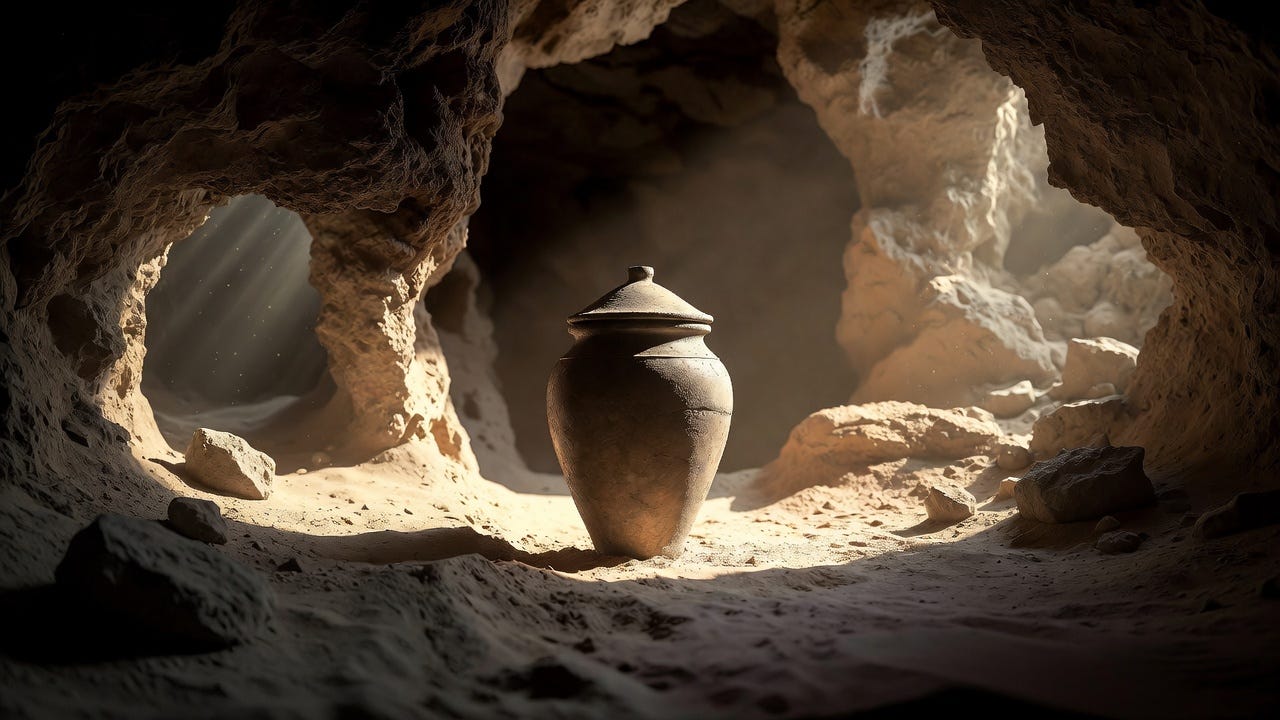
Sometime in the second century before Christ, a community of Jewish men walked away from Jerusalem. Not to another city. Not to another country. Into the desert. The Judean wilderness above the Dead Sea, where the land drops toward the lowest point on earth and the air tastes of salt and the cliffs are honeycombed with caves. They built a settlement at a place called Qumran and they lived there for two centuries and they wrote, and what they wrote they sealed in clay jars and hid in the caves above their settlement and the caves kept their secret for two thousand years until a Bedouin shepherd threw a stone into the darkness in 1947 and heard it hit pottery.
The Dead Sea Scrolls are the testimony of people who saw what we are talking about and could not stay.
Their own documents name what they fled. The Teacher of Righteousness against the Wicked Priest. The corrupted Jerusalem establishment — the high priesthood that had been appointed not by God but by foreign rulers, that had made the Temple into an instrument of political and financial power, that had taken the sacred office and bent it toward everything the Torah forbade. The Essenes called the Jerusalem priests what they were. Usurpers. Defilers. Men who wore the robes of Aaron while serving something else entirely.
These were not outside critics. These were not Romans or Greeks or Samaritans casting aspersions. These were Jewish men, deeply Torah-observant, so committed to the covenant that they chose the desert over compromise. Their Community Rule, their Damascus Document, their War Scroll — these are the documents of people who had looked at the leadership of their own people and recognized the infiltration and refused to normalize it.
They are your witnesses. Hidden in jars. Preserved in the dry air of the desert. Waiting.
Because something else was coming to Jerusalem. Something that would walk into the Temple courts and look at the tables of the money changers and the seats of those selling doves and would not calculate or accommodate or take notes on the sophistication of the operation.
He would overturn the tables.
* * *
“It is not as though God’s word had failed.
For not all who are descended from Israel are Israel.” Romans 9:6
V. Yeshua Came In on a Donkey
Not a warhorse nor a chariot. Not with the apparatus of conquest that every other man who had ever entered Jerusalem with the intention of changing it had brought with him. A donkey, borrowed, its owner apparently asking no questions, and a road covered in cloaks and palm branches by people who had been waiting so long for someone to see what they saw that they would pave the road with their own clothing just to mark the moment.
The am ha’aretz recognized him. That is not incidental; it’s the whole story in miniature. The fishermen and the tax collectors and the prostitutes and the lepers and the woman with the alabaster jar and the blind men on the roadside and Zacchaeus up in his sycamore tree — these were not the Jerusalem establishment. These were the people of the earth. The ones who had always borne the weight of the system without access to its levers. They heard him and they knew him and they followed him in numbers that terrified the people who ran things.
The people who ran things were watching.
He went to the Temple.
What Jesus found in the Temple courts was not an aberration. It was a fully developed system, administratively sophisticated, financially precise — the money changers were not there by accident nor by individual entrepreneurship. They were there because the Temple tax had to be paid in a specific currency, Tyrian shekels, which meant every Jewish pilgrim who arrived in Jerusalem with any other currency had to exchange it, at rates set by the men who ran the tables, in the outer court of the house of God. The dove sellers were not there by accident. Sacrifice required animals certified as ritually pure, which meant the certification belonged to the men who sold them, which meant the price belonged to them too. The whole apparatus sat in the Court of the Gentiles, the one part of the Temple complex where non-Jews were permitted to pray, filling the only space available to the nations with the noise and smell and transactional machinery of a financial operation wearing sacred robes.
Jesus looked at it and overturned the tables.
The Greek word used in Matthew’s account is anestrepsen. He turned them up. He scattered the coins. He drove out the sellers with the cracking of a whip. He would not allow anyone to carry merchandise through the Temple courts. And then, in the ringing silence of scattered money and fled merchants, he said: “It is written, my house shall be called a house of prayer, but you have made it a den of thieves.”
He was quoting two prophets simultaneously. Isaiah 56 and Jeremiah 7. He was telling the men who ran the Temple that he had read their file. That the prophets had named them before he arrived. That what he was doing in that moment was not innovation but confirmation, the same voice that had spoken through Amos and Jeremiah and Ezekiel was speaking again, in a body, in their house, scattering their coins on the stones of their own floor.
The chief priests and scribes heard him and began looking for a way to destroy him.
Matthew 23 is the document that cannot be softened or spiritualized into abstraction. Jesus stands in the Temple and addresses the scribes and Pharisees directly, publicly, with the crowd listening, and he does not lower his voice. Eight times he says woe. Eight times. Woe to you scribes and Pharisees, hypocrites — the Greek word is hypokrites, it means actors, men wearing masks, men performing a role that does not correspond to what is happening behind their eyes. He calls them blind guides. He calls them whitewashed tombs — beautiful on the outside, full of dead men’s bones within. He says they travel land and sea to make a single convert and make him twice the child of hell that they are.
And then he says the thing that makes the whole piece shudder:
“You build the tombs of the prophets and decorate the graves of the righteous and say if we had lived in the days of our fathers we would not have taken part in shedding the blood of the prophets. You testify against yourselves.”
He was telling them directly. You are the descendants of the ones who killed the witnesses. You would have done what they did. You will do what they did. And in saying so he was protecting, defending, the ordinary Jewish people standing in that crowd from being confused with the institution towering over them.
The Pharisees were not the am ha’aretz. The chief priests were not the fishermen from Galilee. The Sanhedrin was not the woman who lost her coin or the father who ran down the road toward his prodigal son. Jesus drew that line with precision and fury and love and he drew it inside Jewish life, defending the people of the earth from the people who had made themselves their masters.
Revelation would name it clearly. Twice. The synagogue of Satan: those who say they are Jews and are not. John was not inventing a new accusation. He was recording the conclusion of everything the prophets and the Essenes and Jesus himself had already documented. There is a counterfeit. It has a name. It wears the robes of the covenant while serving something the covenant forbids.
The infiltrators saw what Jesus was doing and they moved.
What happened next is the hinge on which two thousand years of innocent suffering turns. The leadership class, the high priests, the Sanhedrin, the men whose tables had been overturned, handed Jesus to Rome. Pilate found no fault in him and said so publicly and then handed him back and washed his hands of it and the crowd. The same crowd who a week before waved palm branches, in the same city, at Passover, manipulated and gathered for exactly this purpose by exactly the people who needed this outcome, cried for his blood.
And for two thousand years the bill was sent to the wrong address.
Not to the Sanhedrin. Not to the priestly class that had been consolidating Babylonian-educated power since Ezra came home from exile. Not to the infiltrators who had turned the house of prayer into a den of thieves and the covenant people into a human shield. The bill was sent to every Jewish person in every country in every century who had never set foot in Jerusalem, who had never sat on a council, who had never sold a dove or changed a coin, who had wept at the Chebar or hung their harp in the willows or simply tried to live faithfully inside a tradition that had been weaponized above their heads without their knowledge or consent.
That is not justice. That is the infiltration’s greatest achievement. Getting someone else blamed for what it did.
The ones who built the tombs of the prophets killed the last prophet. Then handed ordinary Jews, true Jews, the sentence.
* * *
VI. Scatter the Sheep, Keep the Shepherds
That is what the diaspora was, underneath the theology and the tragedy and the centuries of wandering that have been called everything from divine punishment to historical accident. Look at who survived the destruction of Jerusalem in 70 AD with their institutional power intact. Look at who did not.
The Zealots died fighting. The Essenes at Qumran were almost certainly massacred by Roman troops, their settlement shows evidence of violent destruction, their scrolls hastily hidden, their community ended. The followers of Jesus scattered and were hunted. The am ha’aretz of Judea were killed in numbers that stagger. Josephus records over a million dead in the siege of Jerusalem alone, numbers historians still debate but none dismiss entirely. The ordinary people of the land bled into the stones of a city the Romans then plowed under and salted and renamed so thoroughly that even its geography was meant to be forgotten.
And the Pharisees?
Rabbi Yohanan ben Zakkai escaped the siege of Jerusalem hidden in a coffin, carried out through the Roman lines by his students, and presented himself to Vespasian and asked for one thing. Not the city. Not the Temple. Not the survival of the people dying inside the walls behind him. He asked for Yavneh. A small coastal town. Permission to establish a school.
Vespasian gave it to him.
What ben Zakkai built at Yavneh was the institutional succession of everything that had sat in Jerusalem. The Sanhedrin reconstituted itself. The oral tradition was preserved and systematized. The rabbinic authority that had operated through the Temple apparatus now operated without a Temple, which meant it operated without the one institution that had at least required physical presence in one place. Now it could travel. Now it could follow the scattered people wherever Rome had thrown them and establish itself above them in every city in every country in the known world.
The destruction of the Temple did not destroy the institution that had corrupted it. It liberated that institution from its only fixed address.
This is the thing that has never been adequately reckoned with. The rabbinical class did not share the fate of the people. It reconstituted above them in exile exactly as it had operated above them in Jerusalem — controlling access to the sacred, defining the boundaries of the community, enforcing compliance through the only tools exile left available. You could not be excommunicated from a Temple that no longer stood. But you could be excommunicated from the community. From the burial society. From the marriage market. From the network of trade and mutual aid that was the only infrastructure keeping Jewish families alive in hostile cities across the Roman Empire and beyond.
Israel Shahak, Jewish scholar, Holocaust survivor, a man with no conceivable motivation to fabricate what he documented, described what this looked like on the ground across the centuries of rabbinic control. He called it one of the most totalitarian systems in human history. Not as an accusation from outside. As a witness from inside. The physical coercion. The rabbinical courts ordering flogging and imprisonment. The ghettos that were not only imposed from outside by hostile governments but created and maintained from inside by a leadership class that needed separation to maintain control.
Shahak’s argument, documented, sourced, written by a man who loved his people, is that the ghetto served the rabbinical class as much as it served the antisemites who surrounded it. Separation enforced dependence. Dependence enforced compliance. Compliance enforced the authority of the men who defined what compliance meant.
The ordinary Jewish people living inside that system were not its architects. They were its raw material.
And periodically, when the raw material became inconvenient, when the symbiotic relationship between the rabbinical leadership class and the governing nobility of whatever country they inhabited became politically untenable, when the people who had been used to administer oppression became the visible face of a resentment that needed an outlet, the leadership class made arrangements.
The arrangements always looked the same. The wealthy and the connected left first. They had foreknowledge because they were party to the decisions. The ordinary people found out when the edict was posted. The expulsions from England in 1290, from France in 1306, from Spain in 1492, the largest and most prosperous Jewish community in the medieval world, the Sephardim, cast out of Iberia with weeks of notice, their property forfeit, their Torah scrolls sometimes their only portable inheritance, these were not bolts from a clear sky to the people who ran things. They were managed transitions. The capital moved before the people did.
The people moved in grief and terror and died on the roads.
Sabbatai Zevi arrived in the seventeenth century and almost brought down Judaism entirely. A false messiah, charismatic and apocalyptic, who gathered hundreds of thousands of Jewish followers across the Ottoman Empire and Europe in a frenzy of messianic expectation, and then, when the Ottoman Sultan gave him the choice between conversion to Islam and death, converted to Islam. The movement should have collapsed. For ordinary Jewish people it did collapse, in grief and humiliation and shattered faith. But his inner circle, the Sabbatean Frankists, the initiated, the ones who had understood from the beginning that the public performance was not the private theology, continued. They went underground. They converted outwardly to whatever was required: Islam, Christianity, Enlightenment rationalism — while maintaining privately a theology that inverted the Torah’s values deliberately and systematically. Sin as sacrament. Transgression as the path to redemption. The public identity as costume.
This is not conspiracy theory. This is documented religious history. Gershom Scholem, the greatest scholar of Jewish mysticism in the twentieth century, documented the Sabbatean Frankist movement in exhaustive scholarly detail. What he documented was a movement that survived its own public failure by going underground and continuing to operate beneath the surface of whatever identity its members publicly wore.
The ordinary Jewish people knew nothing of this. They were busy surviving. Busy keeping Shabbat in cramped apartments in cities that tolerated them provisionally and expelled them periodically. Busy teaching their children the aleph-bet and the prayers and the stories of a God who had promised never to abandon them even when all available evidence suggested abandonment.
They kept faith in the dark. While above them, in the rooms with the closed doors, other decisions were being made in their name.
* * *
VII. The Letter Was Addressed to a Banker
Not to a rabbi. Not to a community elder. Not to any of the millions of ordinary Jewish people scattered across Europe who had been praying toward Jerusalem for two thousand years, who had kept the faith in the cramped apartments and the ghetto streets and the villages of Eastern Europe where Yiddish was the sound of survival and the Shabbat candles were the only reliable light. The letter that would determine the fate of an entire people, that would set in motion the displacement of one population and the militarization of another, that would reshape the Middle East in ways still bleeding today — that letter was addressed to Walter Rothschild. Second Baron Rothschild. One of the wealthiest men on earth. A House that lives and controls to this day.
It was November 2, 1917. Arthur James Balfour, British Foreign Secretary, wrote eleven lines. His Majesty’s Government viewed with favour the establishment in Palestine of a national home for the Jewish people. Eleven lines. A country promised by men who did not own it to men who did not consult the people who would have to live in it. Men who were Jews in name only.
The ordinary Jewish people of Europe did not draft those eleven lines. They did not negotiate them. They did not know they were coming. They were the people the letter was ostensibly about: their ancient longing, their covenant memory, their centuries of exile weaponized as justification. And they were the last people in the room to know when it was written.
Theodor Herzl had been dead for thirteen years by the time Balfour signed his name. But Herzl had built the architecture the letter moved through, and Herzl had left behind his diaries, and his diaries are among the most clarifying documents in this entire history because Herzl did not always remember to be careful.
In 1895 he wrote: “The anti-Semites will become our most dependable friends, the anti-Semitic countries our allies.” He was not writing this in horror. He was writing it as strategy. Antisemitism, in Herzl’s framework, was not the enemy of Zionism. It was its engine. Persecution drove Jews toward the need for a homeland. The worse the persecution, the more urgent the need. The more urgent the need, the more leverage the Zionist leadership had with the European powers who wanted the Jewish question resolved and the Jewish people relocated somewhere other than their own countries.
Herzl understood this with cold clarity. He wrote about the mass of ordinary Jewish people — the Ostjuden, the Eastern European Jews, the ones in the villages and the ghettos — with something that cannot charitably be called love. They were, in his framework, a problem to be solved. Raw material for a national project. People whose suffering was useful precisely because it was suffering.
Chaim Weizmann, who negotiated the Balfour Declaration with the British government, was more polished than Herzl but no less precise. He understood that the British wanted something in return: a strategic foothold in the Middle East, a friendly state in a region about to become enormously important as the Ottoman Empire collapsed. The Jewish people’s ancient covenant connection to the land was the justification. British imperial interest was the mechanism. Rothschild money was the infrastructure.
The ordinary Jewish people were the justification. They were not the negotiators.
Jacob Schiff sits in this history like a stone in a river, undeniable, impossible to route around. An American banker of enormous influence, a partner at Kuhn Loeb and Company, Schiff in 1904 personally financed Japan’s war against Tsarist Russia to the tune of two hundred million dollars. He said so publicly. He was not ashamed of it. His stated motivation was to punish Russia for its treatment of Jewish people. The logical consequence — the anti-Jewish violence that followed in Russia, the pogroms that intensified in the wake of Russian humiliation — drove two and a half million Jewish people out of Russia and into the United States.
John Hays Hammond said clearly that Schiff had done more to worsen the situation of Jewish people in Russia than any other single man, because of his boastful public statements about using Japanese military victory against Russia. The people who suffered the consequences of those statements were not bankers. They were families. They were the ones on the roads again, the ones whose villages were burning again, the ones who arrived at Ellis Island with everything they owned in a single bag.
The pattern is Babylonian in its precision. Create or intensify the conditions that make ordinary Jewish people desperate and mobile. Then direct that desperation toward the project that serves the architects rather than the people.
In Germany it reached its terminus in ash.
The Holocaust is the hardest place in this entire history to speak carefully, because the scale of the suffering demands a silence that writing cannot fill and because the suffering of ordinary Jewish people in Nazi Europe was absolute and real and must never be instrumentalized for any argument, including this one. Six million people. The am ha’aretz. The ones who wept. Families. Children. The scholars and the farmers and the tailors and the grandmothers who remembered when things were different.
They must be named as what they were. Innocent. Betrayed. Sacrificed.
Rabbi Moshe Shonfeld, himself a witness, wrote in Holocaust Victims Accuse what no one who had not earned the right to write it could write. He documented the behavior of the Judenräte, the Jewish councils the Nazis established in occupied territories, populated by existing Jewish leadership and community organizations, and the behavior of the Zionist leadership in Palestine and internationally during the war years. His conclusion was not comfortable. The Zionist leadership in Palestine knew. They had information. And their internal correspondence, documented, archived, not disputed by serious historians, shows a calculus that is almost impossible to read without grief and rage.
Yitzhak Gruenbaum, head of the Jewish Agency’s rescue committee, said in 1943: “One cow in Palestine is worth more than all the Jews of Poland.” He said it at a meeting. It was recorded. He was talking about resources, about whether diaspora Jewish money should be redirected toward rescue operations in Europe or toward building the infrastructure of the future state in Palestine. He chose the state.
The Haavara Agreement of 1933, the Transfer Agreement negotiated between the Zionist Federation of Germany and the Nazi regime, allowed German Jews to emigrate to Palestine, transferring a portion of their assets in the form of German export goods. It kept Zionist immigration to Palestine flowing during the early years of the Nazi regime. It was negotiated by Zionist leadership over the explicit objections of Jewish communities worldwide who were calling for a boycott of Nazi Germany. The boycott would have cost the Nazi regime economically at its most vulnerable moment. The Zionist leadership chose the immigration pipeline over the boycott.
These are not allegations. They are archived documents.
The ordinary Jewish people of Europe did not make these calculations. They were the ones the calculations were made about. They were the ones who needed rescue. They were the ones who died when rescue did not come. And they were the ones who, if they survived, found themselves directed toward a strip of land on the Mediterranean that the architects had already decided would be a war state, surrounded by people whose displacement would guarantee permanent conflict, in a region where peace was never the actual goal.
Because peace would have ended the project’s usefulness.
David Ben-Gurion understood this. In 1938, when the British proposed rescue plans that would have taken Jewish children to countries other than Palestine, Ben-Gurion said: “If I knew it was possible to save all the children in Germany by bringing them to England, and only half of them by transporting them to Eretz Israel, I would choose the second alternative.” He chose the land over the children.
He said it. It is documented. It is in his own words.
The ones who built the state on the suffering of their own people then wrapped themselves in that suffering as permanent justification and permanent protection. The Holocaust became, in the hands of the architects, what Herzl had always said antisemitism could be — the ultimate argument ender. The trump card. The thing that could be played whenever the project required cover.
And ordinary Jewish people around the world, traumatized and grieving and trying to make sense of a catastrophe whose scale had no precedent, were handed an identity built on that trauma and told that the state that had made its calculations in their name was their salvation and their home and the only guarantor of their future.
They deserved so much better.
They deserved the truth. They deserved leaders who chose them over the land. They deserved the rescue that was possible and not chosen. They deserved not to have their grief turned into a weapon wielded by the people who had made calculations about their lives in rooms they were never invited into.
* * *
VIII. The Real Jews Have Always Been the Ones Who Wept
The present proves the past.
The pattern that began at the Chebar: the sorting, the selection, the leadership class that served itself while wearing the covenant as costume, did not end in the ancient world. It did not end in the Second Temple. It did not end when the tables were overturned or when the scrolls were sealed in jars in the desert caves above the Dead Sea.
It arrived at the modern world wearing a new name and carrying a flag and building a wall and it is still, today, handing the bill to the wrong people.
The real Jews have always been the ones who wept.
They are still weeping.
And it is time — long past time — to say clearly, in the full light of documented history, that their tears and their suffering and their covenant faithfulness do not belong to the project that used them. That the am ha’aretz, from Babylon to Berlin to the present, have been not the perpetrators of this history but its most consistent victims. That the ones who claimed to lead them led them into fire. That the ones who claimed to speak for them spoke for themselves.
That the synagogue of Satan is not Judaism.
That the people of the covenant are not the people of the project.
And that the truth, documented, archived, witnessed, sealed in jars and hidden in desert caves and written in the diaries of the architects themselves, has always been available to anyone willing to read it without flinching.
* * *
The river did not care that they were God’s people.
But God did.
And so must we.