

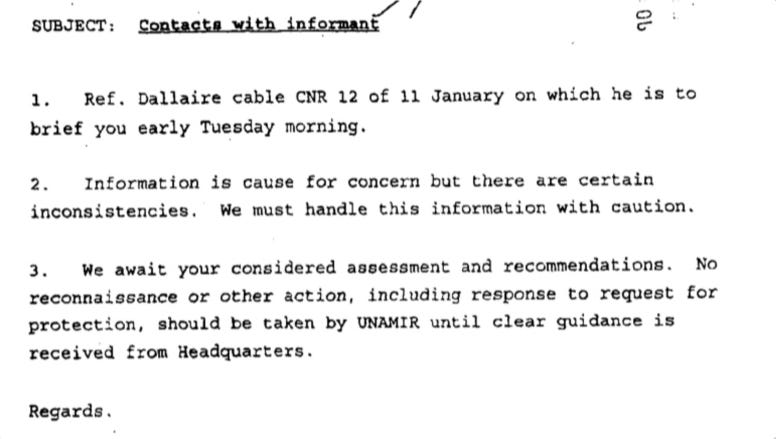
UN response to Lt. Gen. Roméo Dallaire's January 1994 "Genocide Fax," instructing UNAMIR to take no reconnaissance or other action pending guidance from UN Headquarters.
Source: National Security Archive / United States Holocaust Memorial Museum.
Everything in this series is documented. Every claim has a source. The truth is disturbing enough.
Two Requests
Twice in the last decade, the United Nations has asked the world for something. Not conquest. Not command. Something quieter, and in some ways harder to refuse: trust. Reorganize around our framework, the UN said in 2015. Fifteen years, seventeen goals, every nation on earth pulling in the same direction. Ten years later, in the middle of a pandemic whose institutional response had already cost the WHO a great deal of public trust, the UN asked again, this time through its health arm, for something with real legal teeth attached.
The first request came wrapped in idealism. The second came wrapped in treaty language. Between them sits a single fax machine in Kigali, and one unanswered message that still shadows every new promise.
Rwanda: The Fax They Buried
In October 1993, the UN deployed a peacekeeping mission to Rwanda called UNAMIR, twenty-five hundred soldiers, sent to oversee a fragile peace agreement between the Rwandan government and Tutsi rebels. The force was commanded by a Canadian lieutenant general named Roméo Dallaire.
On January 11, 1994, Dallaire sent a cable to UN Headquarters that has since become known as the Genocide Fax. An informant inside the extremist Hutu Power movement had come to him with a warning: militias were being armed and trained, Tutsis in Kigali were being registered, and in the informant’s own words, relayed by Dallaire, his men could kill up to a thousand Tutsis in twenty minutes. Dallaire asked for permission to raid the weapons caches his informant had identified.
The UN Department of Peacekeeping Operations said no. The raid, they told him, exceeded UNAMIR’s mandate. The head of that department at the time was Kofi Annan, a man who would go on to become the UN’s Secretary-General four years later.
Dallaire didn’t stop. He sent five more warnings over the following two months, January 22, February 3, February 15, February 27, March 13, pleading for a broader mandate and more troops. He was turned down every time.
On April 6, 1994, a plane carrying Rwanda’s president was shot down. The genocide began within hours. Extremist militias, the same ones Dallaire had been warning about since January, armed with machetes, began slaughtering Tutsis and moderate Hutus in the streets.
Rwandan customs records examined by human rights investigators show that between January 1993 and March 1994, the same window as Dallaire’s warnings, import licenses were issued for roughly 581,000 kilograms of machetes, a sharp increase over prior years. Businessman Félicien Kabuga, later indicted by the International Criminal Tribunal for Rwanda for genocide, was among the largest documented importers, accounting for tens of tons personally. Some of these shipments, including at least one traced to Kabuga, moved from Chinese manufacturers through the Kenyan port of Mombasa before reaching Rwanda. This is what a thousand deaths in twenty minutes actually required. Not sophistication. Just supply.
Here is where the UN’s actual response, as opposed to its stated principles, becomes impossible to soften. Within days of the killing starting, the Security Council did not reinforce Dallaire’s force. It voted to cut its authorized ceiling from twenty-five hundred soldiers down to two hundred and seventy. On April 21, ten Belgian peacekeepers were tortured and killed after being ordered to hand over their weapons. In the fourth week of the genocide, Secretary-General Boutros Boutros-Ghali ordered a full withdrawal of all UN troops from Rwanda.
Dallaire refused. He called it an immoral order. He stayed, along with roughly two hundred and fifty personnel, close to that reduced ceiling, and did what a skeleton crew with no mandate and no weapons to spare could do. History credits that remnant force with saving thousands of lives that would otherwise have been lost, Tutsi and moderate Hutu alike, sheltered, hidden, and protected by soldiers who’d been told to leave and didn’t. Whatever else this story is, it isn’t a story where every person wearing a blue helmet failed. Dallaire didn’t. His fax didn’t fail either. It was the machine above him that failed to answer it.
Roughly eight hundred thousand people were killed over the next hundred days.
In 1999, Kofi Annan, by then Secretary-General, commissioned an independent inquiry into the UN’s conduct during the genocide. Sit with that fact before you read what it found: the same man who headed the department that refused Dallaire’s raid request in 1994 was, five years later, the one who ordered his own institution investigated for it. The report, when it came, did not spare him or the UN. It concluded that the UN and its member states failed Rwanda in deplorable ways, ignoring evidence that genocide was planned, refusing to act once it was underway, and finally abandoning the Rwandan people when they most needed protection. It found, specifically, that Dallaire’s January cable had reached Annan’s desk and was never shared with the Security Council. It never received the follow-up a warning like that deserved.
Military assessments since have estimated that a reinforced peacekeeping presence of around five thousand troops, twice what UNAMIR had at its peak and roughly twenty times what remained after the Security Council’s cut, could have stopped the worst of the killing. The UN had the smaller number on the ground already. It chose to shrink it.
This is the same body, structurally, that would go on seventeen years later to ask the entire world to reorganize its policy priorities around a shared framework, and thirty-one years later to ask for a legally binding health treaty. The fax and the framework aren’t the same thing. But they were written by the same hand, and one of them is documented proof of what that hand does when the stakes are highest and the mandate is thin.
Agenda 2030: The Ask
On September 25, 2015, all 193 UN member states unanimously adopted General Assembly Resolution A/RES/70/1, formally titled “Transforming Our World: The 2030 Agenda for Sustainable Development.” It laid out seventeen Sustainable Development Goals and 169 underlying targets, covering everything from poverty and hunger to climate, gender equality, and institutional governance, all meant to be achieved by the year 2030.
The document’s language is careful, and worth reading closely rather than taking secondhand. The resolution explicitly states that it applies to all countries while taking into account different national realities, capacities, and levels of development, and respecting national policies and priorities. It commits to respecting national policy space for states. By its own text, the Agenda claims no binding authority over any nation’s sovereignty. It asks. It doesn’t order.
What it does ask for is substantial: a voluntary realignment of national priorities, backed by a financing structure, an annual review process through the High-Level Political Forum, and Voluntary National Reviews that nearly every member state has now submitted at least once. Whether a review process without legal teeth still produces real pressure to conform is a fair question, and not one the resolution’s text answers either way. Nations that fall behind get named in public forums. Nations that comply get held up as models. That’s not sovereignty overridden. It’s a different kind of leverage than a treaty carries.
The Agenda’s reach extends past economics and infrastructure into gender equality targets, educational transformation, and what the document itself calls values-based programming, intended to apply universally, across every culture, every tradition, every faith. That’s a genuinely different kind of ask than a poverty target or an infrastructure goal, since it touches on questions nations, and the people within them, have historically answered for themselves. It’s also worth noting what “universally” actually means among this particular membership. Independent monitors flagged roughly thirty UN member states this year alone for restricting the practice of faith, through imprisonment, violence, or discriminatory law. A call for shared values across every faith carries different weight depending on whether it’s addressed to a nation that protects its citizens’ freedom to hold that faith in the first place, or one that doesn’t.
Eleven years in, the record on all of this is now public, and it’s worth reading in the UN’s own words rather than anyone’s characterization of them. On July 7, 2026, the UN released its official progress report on the Agenda it adopted in 2015. Of the 139 SDG targets with usable trend data, only 36 percent are on track or making moderate progress. Nearly half are advancing only marginally or not at all. Fifteen percent have regressed below where they stood in 2015, meaning the world is now further from those targets than when the Agenda began. An independent academic tracker, the Sustainable Development Report published weeks earlier by the UN Sustainable Development Solutions Network, put it more bluntly: only 16 percent of targets are projected to be met by the 2030 deadline. That same report identified the United States as having moved into what it called active opposition to the sustainable development paradigm, ranking the U.S. last of all 193 member states on commitment to UN-based multilateralism.
The global extreme poverty rate sits at 10 percent in 2026, barely three points below where it stood in 2015, nowhere near the Agenda’s stated goal of eradication. Official development assistance, the funding meant to carry all of this, fell by 23.1 percent in 2025 alone, the largest annual decline ever recorded. The financing gap needed to close the distance now stands at roughly four trillion dollars a year.
An institution asked the world, eleven years ago, to reorganize national priorities, funding, and in some respects cultural values around a shared, globalized framework. With four years left on its own timeline, that same institution’s own numbers show most of the world falling not buying in, and in some cases moving backward. Whether that gap is a warning about voluntary ambition outpacing voluntary compliance, or evidence the ambition itself was mismatched to what nations would actually commit to, the four years remaining on the Agenda’s own clock will be the test.
The Pandemic Agreement: The Ask Expands
On May 20, 2025, the 78th World Health Assembly formally adopted, by consensus, the world’s first Pandemic Agreement. It’s only the second legally binding health treaty in the WHO’s seventy-seven-year history, the first being the 2003 Framework Convention on Tobacco Control. That alone should tell you how rare and significant a step this was.
The sovereignty question here gets misrepresented constantly, in both directions, so it’s worth reading the actual clause rather than anyone’s characterization of it. The Agreement’s own text states that nothing in it shall be interpreted as providing the WHO’s Secretariat, including its Director-General, any authority to direct, order, alter, or otherwise prescribe the domestic law or policies of any party, or to mandate that parties take specific actions such as banning travelers, imposing vaccination mandates, or implementing lockdowns. That sentence is in the treaty. If a piece claims this document hands the WHO command authority over sovereign nations, that piece is wrong.
Here’s what’s true and worth your attention instead. The Agreement’s real operational core, the Pathogen Access and Benefit-Sharing system, the part that would define binding terms like affordable pricing and a twenty percent allocation of pandemic-related products, wasn’t finished when the treaty was adopted. It was deferred to a separate annex, still being negotiated as of this year, with the Agreement structured so it can’t even open for signature until that annex exists. Member states signed onto a framework before its most consequential terms were written.
And the sovereignty concern, while overstated by some, wasn’t invented from nothing. The United States did not participate in the final round of negotiations, following its January 2025 announcement withdrawing from the WHO entirely, and won’t be bound by the pact regardless of what the annex eventually says. Eleven other countries abstained. A peer-reviewed analysis published through WHO-affiliated literature itself attributes the American non-participation specifically to concerns over the binding nature of technology transfer provisions, sovereignty, intellectual property obligations, and financial commitments, concerns serious enough that one of the world’s largest pharmaceutical-producing nations walked away from the table entirely. If I were writing from opinion, I’d count it a mercy, but I promised myself and my readers just the facts, just what the paper trail proves.
So: an institution whose own track record you’ve just read asked, a decade ago, for the world to trust it with a voluntary framework it is now publicly failing to meet. It has just asked again, this time for a binding legal instrument whose central mechanism doesn’t exist yet, and one of the most consequential nations on earth didn’t feel that trust was warranted enough to stay in the room.
Oil-for-Food: What Happens With the Money
If Rwanda shows what the UN does when lives are on the line and Agenda 2030 shows what it does with an unenforceable promise, Oil-for-Food shows what happens when the UN is actually handed money to manage.
The Oil-for-Food Program ran from 1996 to 2003, a sixty-four billion dollar humanitarian operation letting Iraq sell oil under UN sanctions to buy food and medicine for its own people. In April 2004, following reports of massive fraud, Secretary-General Kofi Annan appointed an Independent Inquiry Committee chaired by former Federal Reserve Chairman Paul Volcker, alongside South African Justice Richard Goldstone and Swiss law professor Mark Pieth, to investigate.
Their final report, released in October 2005, found that more than 2,200 companies and individuals, roughly half of everyone participating in the program, paid kickbacks and illegal surcharges, letting Saddam Hussein pocket 1.8 billion dollars at the direct expense of the Iraqi civilians the program was built to feed. Kickbacks flowed from entities in sixty-six countries. Illegal surcharges came from forty. Volcker found conclusive evidence that Benon Sevan, the UN official actually running the program day to day, had placed himself in an irreconcilable conflict of interest by personally participating in the selection of oil purchasers, a direct violation of UN rules.
Annan himself wasn’t cleared of everything. The Committee found no evidence he’d personally influenced a 1998 contract awarded to the company employing his own son, Kojo, but Annan told the Security Council he accepted full responsibility for his own failures and regretted his lack of diligence in pursuing investigations into alleged misdeeds happening under his watch. Separately, Volcker’s investigators discovered that Annan’s chief of staff had approved the destruction of his chronological office files right around the time the inquiry began, which Volcker termed an unfortunate incident without formally accusing anyone of concealment.
Interim findings from the investigation had already produced criminal indictments in the United States, Switzerland, and France before the final report was even published. It remains, by most accounts, the largest financial scandal in the UN’s history.
Peacekeeper Abuse: A Pattern That Hasn’t Stopped
The UN’s own reckoning with this problem goes back to 2005, when a report commissioned in the wake of the Congo scandal, known as the Zeid Report, found peacekeepers engaged in the exchange of sex for money, food, or jobs, and recommended a comprehensive accountability strategy. That’s the UN documenting its own problem in writing, two decades ago, before most of what follows had even happened yet.
The reason this problem persists decade after decade isn’t a mystery, and it isn’t rogue individuals slipping through the cracks. It’s written into the paperwork. Status of Mission and Status of Forces Agreements between the UN and host countries, alongside separate Contribution Agreements between the UN and troop-contributing nations, both reserve full legal jurisdiction over a peacekeeper’s misconduct to that peacekeeper’s own home country. The UN can investigate. It can repatriate. It cannot prosecute. Everything that follows is what that gap has produced in practice.
The Congo mission, first called MONUC, saw allegations surface publicly in 2004: over 150 cases of sexual assault, including 68 cases of rape, alongside prostitution, child pornography, and children fathered and abandoned by peacekeeping personnel. Human Rights Watch investigators interviewed girls as young as thirteen who’d been raped by MONUC soldiers, and others between twelve and fifteen engaged in what’s clinically termed survival sex, trading their bodies for food, money, or protection in a war zone where they had few other options. The UN’s own after-action review of the mission found something worse than isolated misconduct: a management culture, both civilian and military, that had encouraged the abuse by refusing to take it seriously, ignoring reports, and standing by as staff who tried to report abuse were harassed and ridiculed for it. Between September 2001 and January 2004, despite a code of conduct that had existed since 2002, MONUC’s own security branch investigated a grand total of sixteen cases.
The numbers didn’t shrink as the years passed. MONUC faced 181 abuse allegations between 2007 and 2010. Its successor mission, MONUSCO, faced 224 between 2010 and 2021. In the Central African Republic, at least ninety-eight girls reported being sexually abused by peacekeepers from Burundi and Gabon in 2014 and 2015, in incidents that included forced acts of bestiality. The UN identified forty-one troops accused.
The jurisdictional gap is exactly why, when 134 Sri Lankan peacekeepers were found in 2007 to have run a child sex ring in Haiti abusing at least nine confirmed children over three years, 114 of them were sent home, and not one of them ever served a day in jail. Former Secretary-General Ban Ki-Moon himself called this pattern a cancer inside the UN system. Those are his words about his own organization.
This isn’t history you have to reach back decades to find. A UN report released this past April details new sexual abuse investigations tied to the Kenya-led security mission currently operating in Haiti, including a case involving a twelve-year-old child. A UN human rights official responded to the findings by saying four cases is four too many, and calling for independent investigation, prosecution, and real transparency. As of this writing, that call is still being answered, or not, in real time.
The Paper Trail Continues
I keep coming back to the fax. Twenty minutes, the informant told Dallaire. That’s how long it would take to kill a thousand people, and the men with that plan wrote it down, said it out loud, handed it to a general who believed them enough to warn New York five separate times.
New York had a mandate that said no.
That’s the story underneath every part of this piece, whether the subject is a genocide, a corruption scheme, a pattern of abuse spanning three continents, or a resolution asking every nation on earth to trust a fifteen-year plan. An institution’s stated intentions and an institution’s demonstrated conduct are two different documents, and only one of them tells you what actually happens when the moment arrives. Agenda 2030 says it respects national sovereignty, and by its own text, it does. The Pandemic Agreement says the same, and by its own text, it does too. Neither document is the thing to be afraid of.
What’s worth sitting with is the space between what an institution asks permission for and what it does with the authority it’s already been given. Rwanda had a mandate. It was thin, and it was honored to the letter, and eight hundred thousand people paid for that letter being followed instead of a warning being heeded. Oil-for-Food had oversight structures on paper. Peacekeeping missions have had a zero-tolerance policy on paper since before most of the worst abuses even happened. Agenda 2030 has a sovereignty clause, true by its own text, and a compliance apparatus that raises real questions about what that clause is worth in practice.
Paper isn’t the problem. It never has been. The problem is what happens after the paper is signed, and that’s not a question any resolution can answer in advance. It’s only a question the record can answer after the fact. Rwanda answered it in the worst way imaginable. Agenda 2030’s own numbers are still being written, four years out from its deadline, and what they say about the distance between what an institution asks for and what it actually delivers is something every reader of this piece is equipped to judge for themselves.
The paper trail continues
I do not have a paywall for my work, and I never will. I simply want to expose, through paper trails and documented evidence, the corruption among people and entities holding a great amount of power and influence. I am the wife of a Veteran who serves this Republic, and the greater good for our world, to this day. I do not contribute to our household income, because I left the school system —both public and private— and chose to teach my own children at home rather than be an educator teaching in a classroom within parameters that I believe harm our future generation rather than equip. I add the donate link below, only for your consideration to support even a dollar, if you desire. Yet, your reading my work and sharing truth with just one person is priceless, and I value that action more than any donation.
Sources
Rwanda
Roméo Dallaire’s January 11, 1994 cable to UN Headquarters (”the Genocide Fax”)
Report of the Independent Inquiry into the Actions of the United Nations during the 1994 Genocide in Rwanda (the Carlsson Report), commissioned by Secretary-General Kofi Annan, December 1999
UN Security Council records on UNAMIR troop reductions, April 1994
Contemporary reporting on the killing of ten Belgian peacekeepers, April 21, 1994
Alison Des Forges, Leave None to Tell the Story: Genocide in Rwanda, Human Rights Watch / Fédération Internationale des Ligues des Droits de l’Homme, 1999
National Commission for the Fight Against Genocide (CNLG), Genocide Planification report, January 2021
Pierre Galand and Michel Chossudovsky, report on the role of international financial institutions and creditors in the Rwandan genocide, 1996 (source of the Rwandan customs import data on machetes)
International Criminal Tribunal for Rwanda, indictment of Félicien Kabuga
Agenda 2030
UN General Assembly Resolution A/RES/70/1, “Transforming Our World: The 2030 Agenda for Sustainable Development,” adopted September 25, 2015
The Sustainable Development Goals Report 2026, United Nations, released July 7, 2026
Sustainable Development Report 2026, UN Sustainable Development Solutions Network, released June 23, 2026
The Pandemic Agreement
WHO Pandemic Agreement, adopted by consensus at the 78th World Health Assembly, May 20, 2025
Reporting on U.S. nonparticipation following its January 2025 withdrawal from the WHO
Peer-reviewed implementation analysis, WHO-affiliated literature, on member state objections to the Agreement’s binding provisions
Oil-for-Food
Independent Inquiry Committee (Volcker Committee) final report, October 2005
Kofi Annan’s statements to the UN Security Council on the Committee’s findings
Contemporary reporting on related criminal indictments in the United States, Switzerland, and France
Peacekeeper Abuse
A Comprehensive Strategy to Eliminate Future Sexual Exploitation and Abuse in United Nations Peacekeeping Operations (the Zeid Report), 2005
UN Office of Internal Oversight Services investigation findings on MONUC, Congo, 2004-2005
Human Rights Watch investigative reporting on sexual abuse and exploitation by MONUC personnel
Associated Press investigation of UN sexual abuse and exploitation data, 2017
Reporting on the 2007 Sri Lankan peacekeeper case in Haiti
Reporting on 2014-2015 Central African Republic abuse allegations involving Burundian and Gabonese peacekeepers
UN report on sexual abuse allegations tied to the Kenya-led Multinational Security Support mission in Haiti, April 2026
Religious Freedom Context
U.S. Commission on International Religious Freedom, 2026 Annual Report