
UOIEA
The Homeschooling Mother’s Guilt

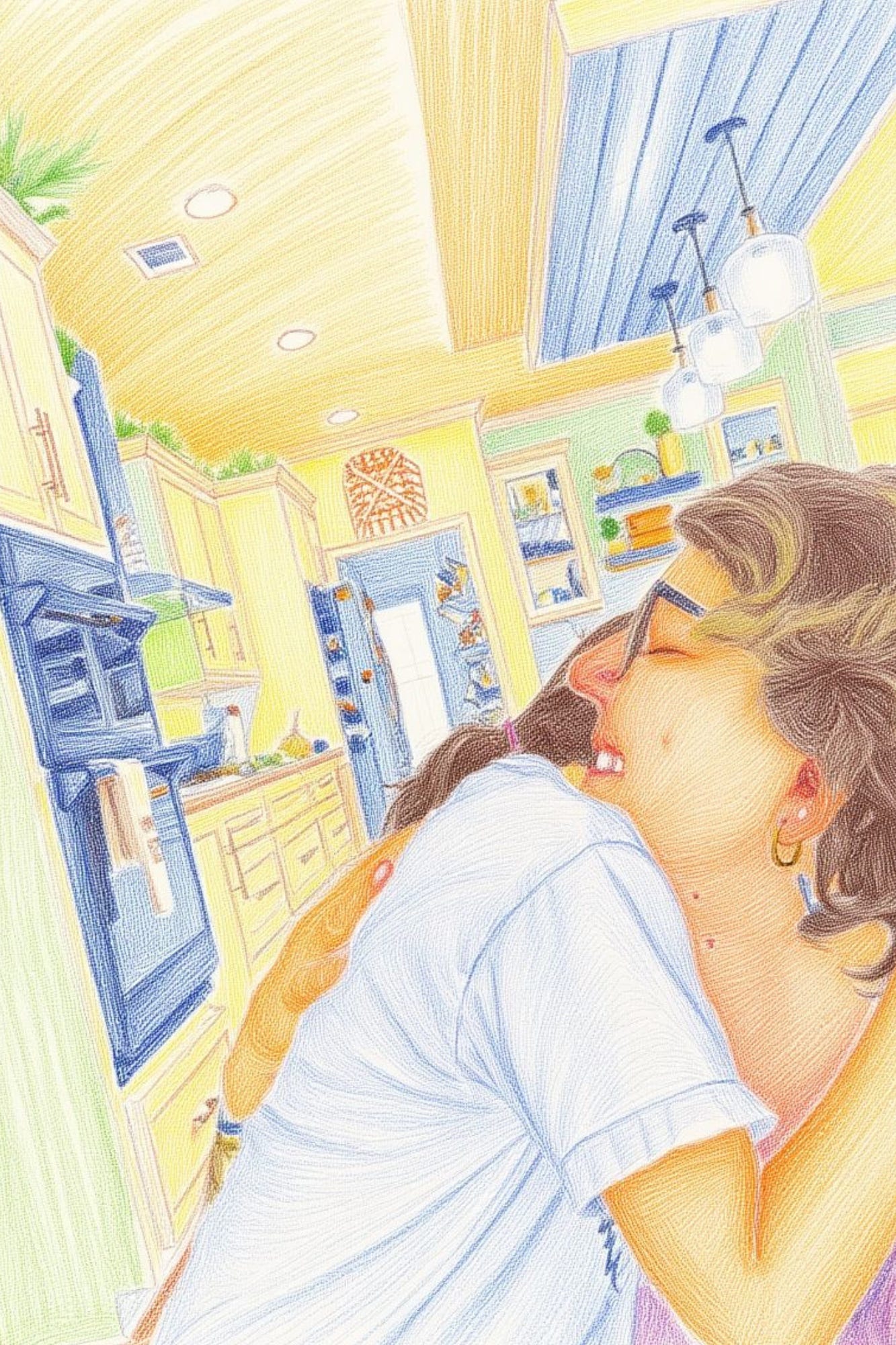
She could read.
I taught her phonics.
She was nine months old when I first understood that I had something extraordinary on my hands. Strapped into her high chair, breakfast smeared across the tray, she moved. Not the wobbly, reflexive movement of an infant startled by sound — she danced. Michael Jackson poured from the speaker and my daughter, nine months old, found the groove in it. She felt the music the way some people feel weather before it changes — in the body, before the mind knows why.
She felt the beat in the music the same way I always have.
It made me so happy.
I knew she was extraordinary.
As she grew, this did not diminish. It deepened. She would listen to a song she had never heard and quietly, almost to herself, begin to predict what was coming next — the chord shift, the key change, the place where the melody would lift or fall. She was reading the architecture of sound the way the rest of us read words on a page: fluently, unconsciously, for joy.
If I sift through my videos of her dancing at restaurants, the grocery store, and ordinary at home moments—her moves, her expectation of change in songs unheard and predictive moves, have been an a constant anomaly our whole family has endeared.
She was brilliant.
She is brilliant still.
I want to be clear about that before I tell you the rest of this story, because the rest of this story is about me, and my failure, and a guilt I do not yet know how to put down.
We chose to homeschool because we believed — and fiercely still believe — it was the right choice. The intimacy of it. The ability to meet a child where they are, to move at their pace, to notice. That last word matters more than I can adequately express now.
To notice.
We did the phonics work. I want you to understand the weight of that sentence. We did not do a little phonics work, or enough phonics work, or some phonics work when we remembered. We did so much phonics work. Repetition. Patterns. Letter sounds mapped to symbols, symbols mapped to words, words strung into meaning. We were methodical. We were consistent. We were, I believed, thorough.
She’s the youngest of a long line of readers. She was proving progress. So, we moved on.
She learned to read. I watched her do it.
I watched her do it.
She sat with books and her eyes moved across the lines, her finger tracking the words. And she told me what the words said. I checked the box. I moved on.
The moment I understood came quietly, the way most devastating things do. No dramatic revelation. No single image that told the whole story at once. Just a small thing I could not stop seeing once I had seen it.
She was reading. Her finger moved along the line. And she was not looking at the page.
I watched it happen more than once, turning it over in my mind, pressing on it the way you press on something that might be broken to find out if it is. She had not been reading. She had been remembering. She had been pattern-matching at a level of sophistication so extraordinary that I — her mother, her teacher, the person who’s singular purpose was to notice — had not caught it. Not once.
And then my brain began cycling. Asking me in the car: “what is the limit speed?”. Asking me with blurry, blinking early morning eyes: “what are we having for linner?'“. I counted these off as precious mother journaling moments — to not forget the way our children said the cutest things when they were little.
She has had a broad language introduction, and lots of read-to time. She is the youngest. She figured out and memorized word shapes. She is more creative than children years older, and at a minimum, two years ahead of her level in math.
I thought she was progressing, even when phonemes were a struggle.
She wasn’t. She memorized. And I did not see it.
She outmasked me. One on one. Every single day.
Think about what that means. In a large classroom, with thirty children, with a teacher managing noise and behavior and state standards and lunchroom schedules — she might never have been found. Her masking was that complete. Her intelligence was that adaptive. The very gifts that made her extraordinary made her invisible in the place where she most needed to be seen.
We were her best chance, and I missed it.
Here is what I know, and what I tell myself, and what I believe on most days with most of my heart:
She will be fine. More than fine. A brain like hers can do beautiful things others cannot. She will be extraordinary in ways I cannot yet map.
She will retrain her brain — children do, young brains do, and her brain in particular, the one that hears the architecture of music before it arrives, will find its way to reading the architecture of language too. I have no real doubt about her future. I carry it like a lantern. She is just six years old. As I type this, my heart still aches. Because I could have caught it sooner. I should have.
I know that homeschooling put us in the best position to catch this at all. I know that one-on-one time gave us the proximity to eventually see what a classroom might have buried for years. I know the research on twice-exceptional children — gifted children with learning differences — and I know what happens when their gifts get them by long enough that no one ever looks beneath them.
I know all of this. I believe all of this.
And still.
There is a particular grief that lives inside the word still. The grief that does not argue with your good logic. The grief that sits beside your certainty and does not leave. I know she will be okay, and still I failed her. I know we caught it, and still I missed it for years. I know she is safe, and still I was the one person on this earth most positioned to see her, and I did not see her.
Mom guilt is the phrase we use because it is short and it fits on a bumper sticker and it has the decency to sound manageable. What it actually is — the variety I am speaking of here — is something closer to grief. It is the grief of loving something so completely that your failure to protect it becomes a failure of the self. Not what I did wrong. What I am.
I taught her phonics. I did the work. I sat beside her, letter by letter, sound by sound, through the vowels — A E I O U — and believed I was building something solid. I was. I was also missing the thing underneath, the drift in the foundation, the quiet gap between what she showed me and what was true.
U ,O, I ,E , A
She could read, and I believed her, and that is the part I cannot forgive myself for yet. Not the believing — the yet. The not-yet-forgiven. I am sitting in it. I am choosing not to look away from it too quickly, because I think the looking matters. I think the mothers who skip past their failures do not learn from them. I think I owe it to her — and to this — to stay in the discomfort long enough for it to mean something.
·
If you love a child fiercely, you know the particular terror of being the one responsible for them. The love is enormous and so the stakes are enormous and so the failures are enormous too, even the ones that are ordinary, even the ones that are human, even the ones that every parent of every child makes in some form or another because we are finite and imperfect and our children are complex beyond what we can fully hold.
She danced in her high chair at nine months old. She hears music the way some of us hear language — as a native tongue, arriving whole. She is brilliant and masked and adaptive and mine, and she trusted me to see her, and I am learning — slowly, imperfectly, still — what it means to truly look.
U, O, I, E, A.
We will go back to the beginning. We will do the work again, differently this time, with new eyes. She will get there. I already know she will get there.
The part I have not yet figured out is how to let myself off the hook for not being smarter, faster, more perceptive than I was. Maybe I am not supposed to let myself off the hook. Maybe this is what it means to take the responsibility seriously enough. Maybe the guilt, in its way, is also love.
I taught her phonics.
I am still learning how to see her.
And I always will be. That part, at least, I can promise her.
But, my mama heart is hurting. And trying to figure out a way forward to accept forgiveness.
— The Homeschooling Mother