

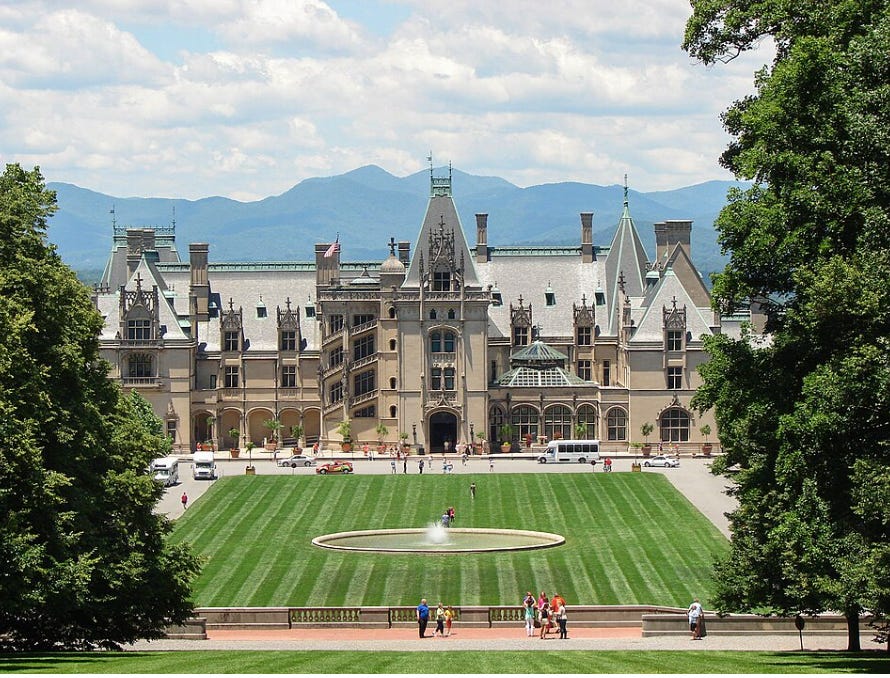
I have stood in front of the Biltmore Estate exactly once, and I remember thinking two things: this is more unnerving than beautiful, and this man had a problem.
Not a bad problem, exactly. More the kind of problem that happens when someone with extraordinary taste, extraordinary resources, and zero one telling him no decides to build a summer home in the Blue Ridge Mountains of North Carolina. The result is 175,000 square feet of French Renaissance château, 250 rooms, 65 fireplaces, a bowling alley, and an indoor swimming pool that holds 70,000 gallons of water.
For a summer house.
If you’ve been to Biltmore, or if you’ve always meant to go, here’s a few details they don’t put on the standard brochure.
The name is a combination of two words George made up.
George Washington Vanderbilt II was the youngest son of William Henry Vanderbilt, which meant he grew up wealthy, cultured, and largely left alone to read books and travel the world. When he and his mother started taking trips to the Asheville area, he fell in love with the mountains and decided to build there. He named his estate “Biltmore” by stitching together “De Bilt” — the ancestral land his Dutch family came from in the Netherlands — and “more,” meaning open, rolling land. So the name is half Old World roots and half Southern landscape, which is honestly a more poetic origin story than most houses get.
It took its own railroad to build it.
Construction started in 1889 and wrapped up in 1895. Given the scale of the project, it required a dedicated brick kiln, a woodworking factory, and a private railroad to haul in materials. The total cost came to five million dollars, which works out to somewhere around $164 million today, and that’s before a single piece of furniture went through the door.
The finished house has 35 bedrooms, 43 bathrooms, and 250 rooms total. The fireplaces alone, all 65 of them, could heat a small village.
The estate used to be the size of a small country.
Today, Biltmore sits on about 8,000 acres, which is already a staggering amount of land. But at the turn of the twentieth century, the estate covered close to 125,000 acres — larger than 17 recognized countries.
George eventually began selling land to the federal government before he died, with the stipulation that it stay wild and undeveloped. That land became the Pisgah National Forest. So the next time you’re hiking through Pisgah, you’re essentially on what used to be somebody’s backyard.
George Vanderbilt was basically an early sustainability advocate.
This is the one that surprises people. The Gilded Age is not exactly known for its environmental conscience, but George enlisted Frederick Law Olmsted, the landscape architect behind Central Park, to design the grounds with long-term sustainability in mind. They brought in livestock, farmed the river bottoms, and engineered natural transitions between the formal gardens and the surrounding forest.
He also hired a professional forester named Gifford Pinchot to manage the land, and later a German forester named Carl Schenck, who established the Biltmore Forest School — the first school of forestry in North America. George Vanderbilt was either truly worried about the land long before it was fashionable to be or preparing for nuclear fallout. Take your pick.
The winery used to be the cow tunnel.
The Biltmore Winery opened in 1985, started by George’s grandson William Cecil, who converted what had been the dairy barn into one of the most-visited wineries in the country. They now produce around 150,000 cases of wine a year and ship to 40 states.
The charming, sparkling walkway that leads visitors to the winery today? It used to be the tunnel the staff used to move cow manure. You’re welcome.
The Vanderbilt name kept making headlines long after George was gone.
William Cecil wasn’t the only grandchild carrying the family name into the twentieth century. There was also Gloria Vanderbilt — George’s granddaughter, heiress, socialite, artist, fashion designer, and mother of CNN anchor Anderson Cooper. Gloria became famous in her own right, and then famous again, and then again after that, in the way that very wealthy people with very complicated lives tend to do.
She is perhaps best known to a certain generation for her designer jeans or penchant for strange decor. To another generation, for the custody battle she was at the center of as a small child — fought over by her mother and her aunt in a very public court case that the tabloids dubbed the “trial of the century,” leaving a little girl to be passed between adults who each wanted her money more than they wanted her. The press called her “the poor little rich girl,” which managed to be both accurate and completely useless at the same time.
She had four husbands, three sons, a career in fashion, and a memoir. She died in 2019 at 95, having outlasted most of the drama written about her — which is one way to win.
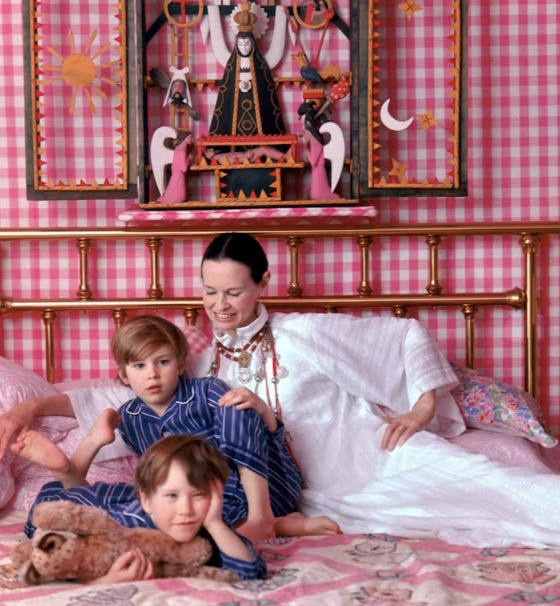
[Photo: Gloria Vanderbilt with Anderson Cooper and his brother Carter, circa 1972.
Jack Robinson/Getty Images]
George kept a reading journal from age 12 until he died.
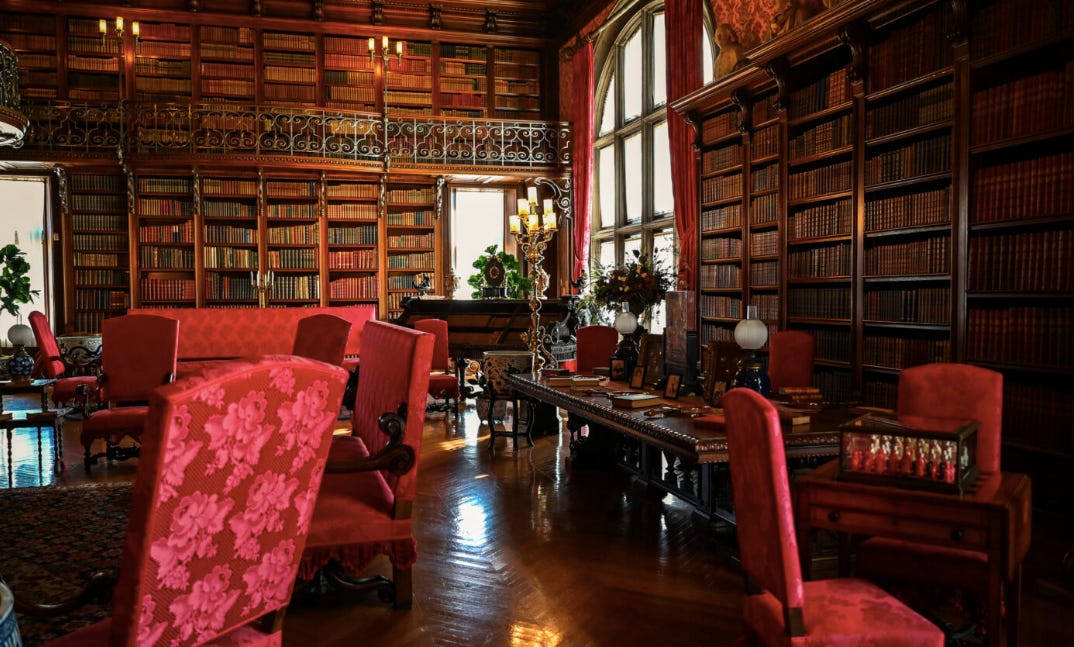
The library at Biltmore House is two stories tall and holds over 24,000 books. George read more than 80 of them every year. He tracked every book he’d ever read in a personal journal he started at age twelve. It is, essentially, a pre-internet Goodreads account kept entirely by hand.
If you love books, this one rivals the Beast’s gift to Belle. Just darker.
The house has secret passageways. Everywhere.
Not because George Vanderbilt was running some kind of aristocratic spy operation — the hidden doors were for the serving staff, so they could move through the house and deliver meals without being conspicuous. There are concealed doorways in the library and the breakfast room. There’s also a marble-covered trap door in the Winter Garden with a ladder underneath it.
Where does the ladder go? Nobody who works there seems to be in a hurry to tell you. If you find out, let me know. Or…on second thought, maybe keep it to yourself.
It was the first home in Asheville to have an elevator.
George had electricity wired in from the beginning. He was friends with Thomas Edison, who gets credit for the initial installation, though the inferior DC current was eventually upgraded to AC. The elevator is still running today.
He also put in the first private bowling alley and that now-legendary 70,000-gallon swimming pool, complete with ropes along the side for emergency use. And apparently a hot spot for the tin-foil hats. No judgement here!
The oak leaves and acorns are everywhere, and they mean something.
The Vanderbilt family crest features oak leaves and acorns as symbols of strength, growth, and longevity. Once you know that, you’ll start noticing them woven into stonework, copper flashing, and decorative metalwork all over the estate. George’s initials show up throughout as well. The whole house is, in a sense, a monogram of the man who built it.
It might be haunted. Probably. Possibly.
Visitors standing near the main marble fireplace have reported hearing a woman’s voice calling out — thought to be Edith Vanderbilt, calling for George. Down in the underground swimming pool, people have claimed to hear maniacal laughter coming from the drain and felt cold water on their skin when there was none.
Whether you believe any of that or not, a 250-room mansion built in the 1890s with secret passageways and a ladder into unknown darkness has earned the right to a few ghost stories. The gargoyles add to the charm, of course.
It has been in more movies than you probably realize.
Forrest Gump. Patch Adams. The Last of the Mohicans. Hannibal. The Odd Life of Timothy Green. The estate’s grounds and interiors have stood in for everything from Southern estates to European palaces. If you’ve ever watched a movie and thought that house looks familiar, there’s a decent chance it was Biltmore.
If you are planning a visit, the home’s dedicated website is the best place to ensure dates of closure. Although the house remains open 365 days a year, it does close during film-making (and of course, for repairs and such).
There is something about the Biltmore Estate that refuses to stay in the past. It’s still a working winery, a hotel, a trail system, a living landscape managed the same way Olmsted and Pinchot laid it out over a century ago. A set for movies. A plot for books. And one of the most enduring places in the American South.